
What's Happening?
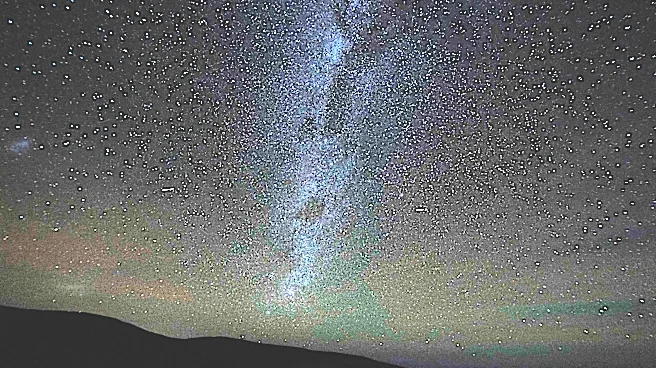
An amateur astronomer has captured a highly detailed image of the Small Magellanic Cloud (SMC) using a standard camera and telephoto lens from Cerro Pachón, Chile. This achievement challenges the notion
that only professional observatories can produce high-quality astronomical images. The SMC, a dwarf galaxy near the Milky Way, was photographed by Petr Horálek, who utilized a four-hour exposure to reveal intricate details typically associated with space telescopes. This effort highlights the potential for ground-based astrophotography to achieve remarkable results under optimal conditions.
Why It's Important?
This development signifies a shift in the field of astronomy, where advanced imaging is becoming more accessible to amateur astronomers. The ability to capture such detailed images from Earth democratizes astronomical observation, allowing more individuals to contribute to scientific understanding. This trend could inspire a new generation of astronomers and increase public engagement with space science. The success of this project also emphasizes the importance of environmental conditions, such as low light pollution and stable atmospheric conditions, in achieving high-quality astronomical images.
Beyond the Headlines
The capture of the SMC from Earth reflects broader changes in how astronomical research is conducted. As technology advances, the line between amateur and professional astronomy blurs, fostering collaboration and innovation. This democratization of astronomy could lead to more discoveries and a deeper public appreciation for the cosmos. Additionally, the project underscores the role of outreach programs like NOIRLab Audiovisual in bridging the gap between scientific research and public engagement, making complex astronomical concepts accessible and inspiring curiosity about the universe.