





What's Happening?
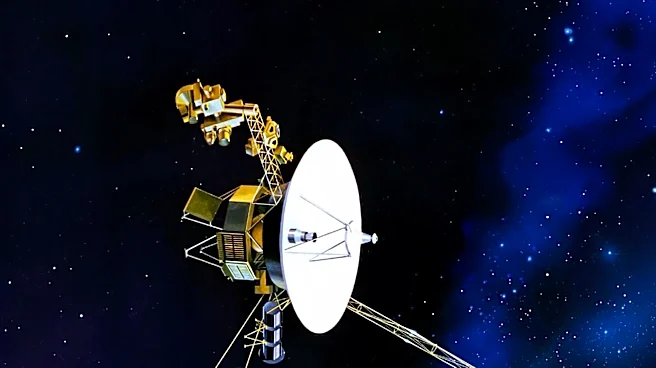
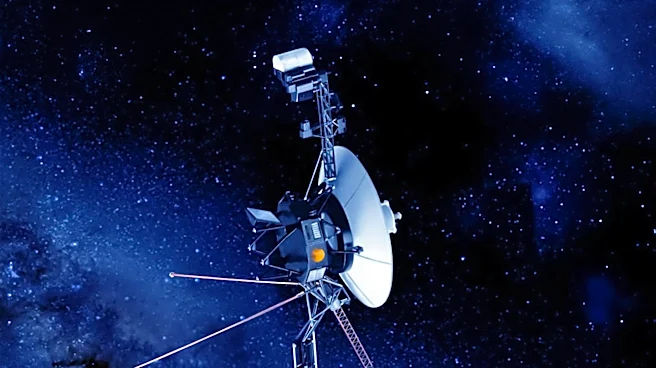
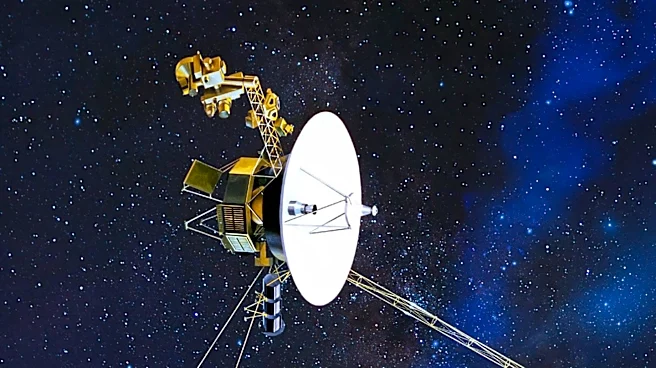
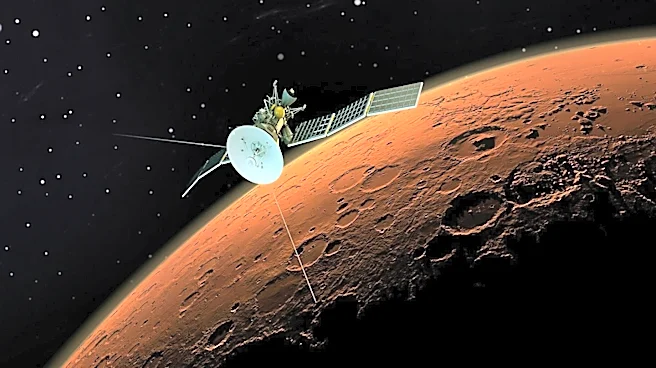
NASA's Voyager 1 and 2, launched in 1977, were initially designed for a five-year mission to explore Jupiter and Saturn. However, nearly 49 years later, both spacecraft are still operational and transmitting data from interstellar space. The mission,
managed by NASA and operated by the Jet Propulsion Laboratory, has exceeded its original scope due to a rare planetary alignment that allowed the probes to use gravitational assists to extend their journey. Voyager 1 crossed the heliopause in 2012, followed by Voyager 2 in 2018, marking their entry into interstellar space. Despite the challenges of operating aging technology, the mission continues with reduced power, focusing on maintaining communication and collecting valuable scientific data.
Why It's Important?
The continued operation of the Voyager probes is significant for several reasons. Scientifically, they provide unique data from interstellar space, offering insights into the heliosphere's boundary and the interstellar medium. This information is crucial for understanding the solar system's interaction with the galaxy. Technologically, the mission demonstrates the durability and adaptability of space engineering, as the probes have outlasted their expected lifespan by decades. The mission also highlights the importance of long-term planning and international collaboration in space exploration. The data collected by Voyager contributes to our understanding of space environments, which is essential for future deep-space missions.
What's Next?
NASA plans to continue operating the Voyager probes as long as possible, with current projections suggesting they may remain functional into the 2030s. Engineers are working on power-saving strategies to extend the mission's life, such as shutting down non-essential systems and instruments. The mission's longevity depends on the gradual reduction of power from the probes' radioisotope thermoelectric generators. As the mission progresses, NASA will focus on maintaining communication and maximizing scientific returns. The potential for unexpected technical failures remains, but the mission team is prepared to address challenges as they arise.
Beyond the Headlines
The Voyager mission underscores the importance of preserving institutional knowledge and expertise. Many of the engineers who originally worked on the mission have retired, but their knowledge is passed down to new generations of scientists and engineers. This continuity is vital for managing long-term projects and adapting to unforeseen challenges. The mission also raises questions about the future of space exploration and the potential for human-made objects to travel beyond the solar system. As the probes continue their journey, they serve as a testament to human curiosity and the desire to explore the unknown.