
What's Happening?
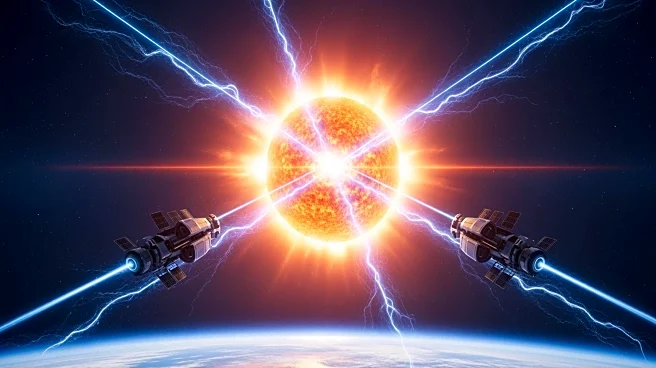
Astronomers have potentially observed a 'superkilonova,' a rare cosmic event combining elements of both supernova and kilonova explosions. The event, named AT2025ulz, was detected on August 18, 2025, by gravitational wave detectors LIGO and Virgo, followed
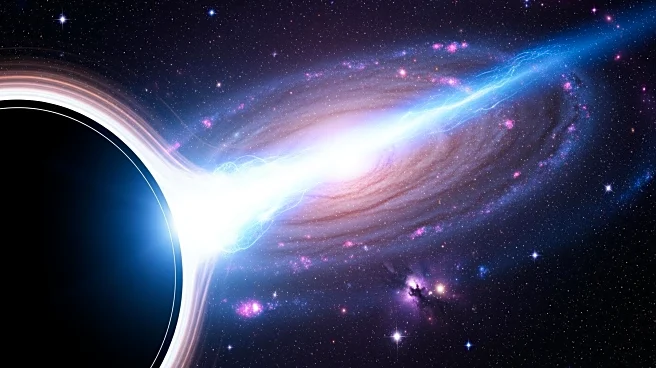
by visual confirmation from the Zwicky Transient Facility. Initially, the event resembled a typical kilonova, characterized by the merger of neutron stars and the creation of heavy elements like gold. However, the event's light unexpectedly brightened and shifted to bluer wavelengths, indicating the presence of hydrogen, a signature of a supernova. Researchers propose that a massive, rapidly spinning star exploded as a supernova, splitting into two neutron stars that later merged, creating a kilonova within the supernova's debris. This hybrid explosion challenges existing stellar physics, particularly the mass of neutron stars, as one of the merging objects was less massive than the sun, contrary to conventional predictions.
Why It's Important?
The potential discovery of a 'superkilonova' has significant implications for our understanding of stellar evolution and the formation of heavy elements in the universe. If confirmed, this event could redefine the boundaries of stellar physics, particularly regarding the mass and formation of neutron stars. The findings suggest that neutron stars can form at lower masses than previously thought, which could lead to new models of star life cycles. This discovery also highlights the importance of gravitational wave astronomy in uncovering new cosmic phenomena, offering insights into the complex processes that govern the universe. The event's unique characteristics may prompt further research and observations, potentially leading to more discoveries of similar phenomena, thereby expanding our knowledge of the cosmos.
What's Next?
To confirm the existence of a 'superkilonova,' astronomers will need to observe more such events. Future sky surveys, such as those from the Vera C. Rubin Observatory and NASA's Nancy Grace Roman Space Telescope, are expected to play a crucial role in identifying similar occurrences. These next-generation observatories will provide more comprehensive data, allowing researchers to test the proposed theories and refine models of stellar explosions. Additionally, continued advancements in gravitational wave detection will enhance the ability to capture and analyze these rare cosmic events. The scientific community will likely focus on understanding the conditions that lead to such hybrid explosions, potentially leading to breakthroughs in astrophysics and cosmology.