






What's Happening?
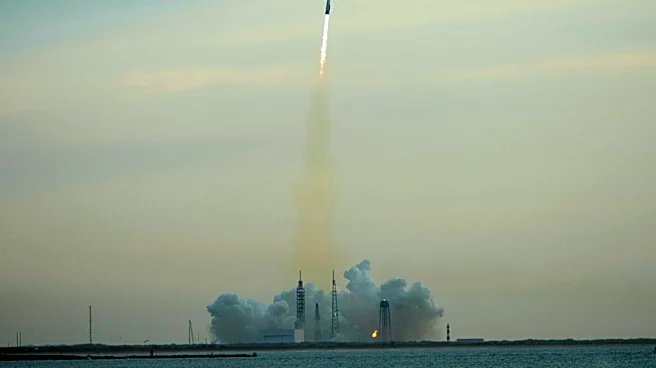
The Artemis II mission, conducted by NASA, marked a significant milestone in space exploration as it became the first crewed mission to the Moon in over 50 years. The mission involved a flyby of the Moon using the Orion spacecraft, which was launched
from the Kennedy Space Center in Florida. The crew consisted of Commander Reid Wiseman, Pilot Victor Glover, and Mission Specialists Christina Koch and Jeremy Hansen from the Canadian Space Agency. This mission was notable for its diverse crew, including the first woman, Black man, and Canadian to travel to the Moon. The mission's objectives included testing the spacecraft's systems and conducting a lunar flyby to gather data and images of the Moon's surface. The crew successfully completed the mission and returned to Earth, splashing down in the Pacific Ocean.
Why It's Important?
The Artemis II mission is a pivotal step in NASA's long-term goals of establishing a sustainable human presence on the Moon and eventually sending astronauts to Mars. By successfully testing the Orion spacecraft and its systems, NASA has laid the groundwork for future missions that will involve landing on the Moon and potentially building a lunar base. The mission also set a new record for the farthest distance traveled by humans from Earth, surpassing the previous record set by Apollo 13. The diverse composition of the crew sends a strong message about inclusivity in space exploration, highlighting NASA's commitment to diversity and representation in its missions.
What's Next?
Following the success of Artemis II, NASA is preparing for the Artemis III mission, scheduled for mid-2027. This mission will involve technology demonstrations with commercially built moon landers from companies like SpaceX or Blue Origin. The goal is to conduct a moon landing during the Artemis IV mission in 2028. NASA plans to use these missions to further explore the Moon for scientific discovery and economic benefits, ultimately establishing a human presence on the lunar surface and paving the way for future missions to Mars.