



What's Happening?
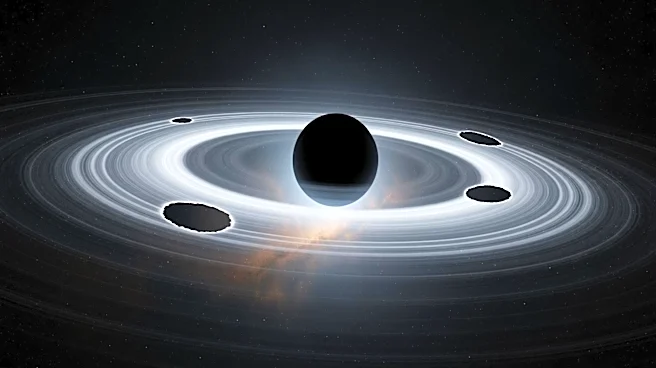
Researchers from the Max Planck Institute for Solar System Research have identified a significant planet-forming region just beyond Jupiter's orbit. This area, described as a 'breeding ground' for planetesimals, has been studied using computer simulations.
The findings suggest that this region produced planetesimals with diverse compositions over approximately two million years. The study highlights how a ring of higher gas pressure beyond Jupiter trapped dust, facilitating the rapid formation of planetesimals. This discovery connects these simulated objects to known groups of meteorites found on Earth, providing new insights into the early stages of the Solar System's development.
Why It's Important?
The identification of this planet-forming region is crucial for understanding the early processes that shaped our Solar System. By revealing how diverse planetesimals formed, the study offers insights into the origins of meteorites and the building blocks of planets. This research could impact our understanding of planetary formation and the conditions that lead to the development of habitable worlds. The findings may also influence future studies on the evolution of the Solar System and the potential for similar processes in other star systems.
What's Next?
Future research may focus on further simulations to explore the long-term evolution of planetesimals in this region. Scientists might also investigate the implications of these findings for other areas of the Solar System and beyond. The study could lead to new models of planetary formation and influence the search for exoplanets with similar conditions. Additionally, the connection to meteorites found on Earth may prompt further analysis of these samples to refine our understanding of their origins.