




What's Happening?
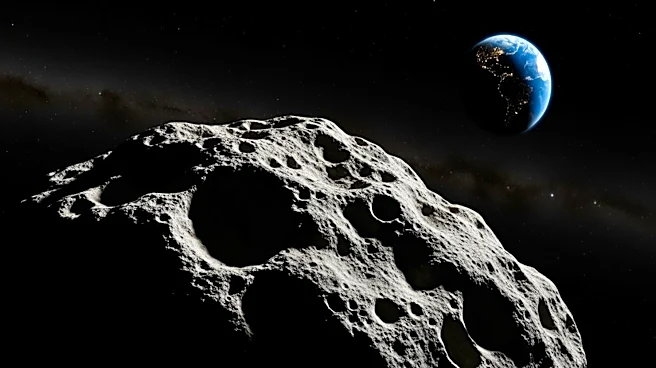
A recent study published in Earth and Planetary Science Letters reveals that meteorites known as angrites are remnants of a protoplanet that was destroyed in the early solar system. These meteorites, characterized by their unique volcanic compositions,
suggest they originated from a large ancient object with differentiated layers, including a metallic core and a magma ocean. The research, led by Aaron Bell from the University of Colorado, Boulder, provides the first unequivocal evidence supporting the hypothesis that these angrites are samples from a protoplanet that was catastrophically disrupted. This protoplanet, referred to as the angrite parent body (APB), may have been as large as Earth's moon, indicating that significant planetary bodies existed in the early solar system.
Why It's Important?
The discovery of angrites as remnants of a lost protoplanet offers crucial insights into the early stages of planetary formation in our solar system. Understanding the composition and origin of these meteorites helps scientists reconstruct the conditions and processes that led to the formation of planets. The study suggests that large planetary embryos could form within the first few million years of the solar system's evolution, challenging previous assumptions about the size and nature of early celestial bodies. This research not only enhances our knowledge of solar system history but also informs models of planetary accretion and differentiation, which are fundamental to understanding Earth's own formation and evolution.
What's Next?
Future research will likely focus on further analyzing angrites and other meteorites to refine our understanding of early solar system dynamics. Scientists may explore additional samples to confirm the size and characteristics of the angrite parent body. This could involve developing more advanced geobarometers to measure the pressures at which these rocks formed, providing deeper insights into the conditions of early planetary bodies. Additionally, the study may prompt a reevaluation of existing models of planetary formation, potentially leading to new theories about the diversity and evolution of celestial bodies in the solar system.
Beyond the Headlines
The findings about angrites highlight the complexity and diversity of early solar system bodies, suggesting that the path to planet formation was not uniform. The unique geochemical properties of angrites indicate that the APB was on a different evolutionary trajectory compared to Earth and its neighbors. This raises intriguing questions about the potential for other 'lost worlds' that may have existed and been destroyed, leaving only fragmentary evidence. The study underscores the importance of meteorites as time capsules that preserve the history of the solar system, offering a glimpse into the processes that shaped the planets we see today.