



What's Happening?
Katalyst Space and NASA have abandoned their plans to reboost the Swift gamma-ray observatory using Katalyst's Link spacecraft. The decision was made after Link experienced ongoing attitude-control issues, including the loss of two of its three reaction
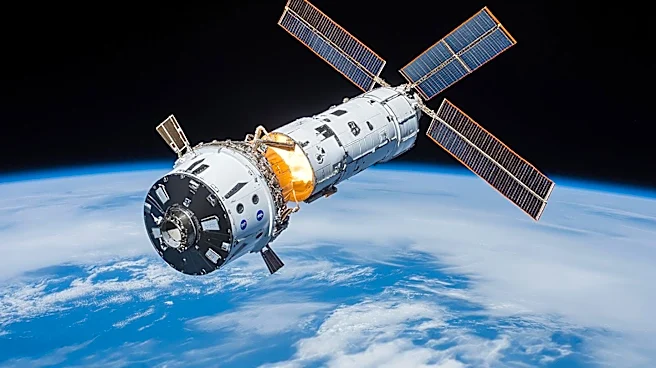
wheels and partially functioning reaction control system thrusters. The Link spacecraft, launched on July 3, was intended to grapple Swift and raise its orbit, which was decaying faster than anticipated due to increased atmospheric drag from high solar activity. Despite initial reports of Link being in good condition, problems emerged by late July, causing the spacecraft to enter a multi-axis spin. While Katalyst managed to slow the spin and install new flight software, both the company and NASA concluded that Link could not safely perform the reboost. Instead, Link will now conduct rendezvous and proximity operations near Swift to gather data for future satellite servicing missions. The Swift observatory, launched in 2004, is now expected to reenter Earth's atmosphere later this year, as its science operations had already been curtailed to reduce atmospheric drag.
Why It's Important?
This decision highlights the inherent risks and complexities involved in advanced satellite servicing missions, particularly those undertaken on aggressive timelines. The failure to reboost Swift means the premature end of a valuable scientific asset, impacting ongoing research into gamma-ray bursts and other astrophysical phenomena. For Katalyst Space, while the reboost mission was unsuccessful, the experience gained from developing and operating Link, even with its malfunctions, is crucial for advancing U.S. capabilities in satellite servicing. NASA's willingness to undertake such a 'high-risk, high-reward' mission underscores its commitment to fostering innovation and developing new technologies for space operations. The lessons learned from Link's operational challenges will inform future designs and strategies for in-orbit servicing, deorbiting services, and space debris mitigation, which are increasingly vital for the sustainability of space activities. This event also emphasizes the impact of space weather, like solar activity, on satellite longevity and the need for robust orbital maintenance solutions.
What's Next?
Katalyst Space will continue to operate its Link spacecraft to perform rendezvous and proximity operations in the vicinity of Swift. The company aims to use these remaining operations to gather valuable data and learn lessons that can be incorporated into its future satellite servicing missions. Katalyst was recently selected by the Space Development Agency and Defense Innovation Unit for study contracts related to deorbiting services, suggesting a continued focus on in-orbit servicing technologies. NASA will not attempt to reactivate Swift's science instruments for its final months, as the spacecraft is now expected to reenter Earth's atmosphere later this year. The agency plans to prioritize finding new options to respond rapidly to cosmic events, utilizing current missions to help fill the scientific gap left by Swift's impending reentry. The insights gained from this mission, despite its outcome, are expected to contribute to building a repeatable playbook for future rendezvous, proximity operations, and satellite servicing endeavors.
Beyond the Headlines
The Swift reboost mission, despite its ultimate failure, represents a significant step in the evolving landscape of in-orbit satellite servicing. This field is critical for extending the lifespan of valuable space assets, managing space debris, and enhancing national security capabilities in space. The challenges faced by Katalyst's Link spacecraft underscore the technical hurdles that still need to be overcome for routine and reliable satellite servicing. The 'high-risk, high-reward' approach taken by NASA and Katalyst reflects a broader shift towards embracing innovative, albeit challenging, solutions to maintain and enhance space infrastructure. The data collected from Link's operations, even in its compromised state, will contribute to a deeper understanding of spacecraft autonomy, attitude control systems, and the complexities of close-proximity operations in orbit. This experience will likely influence future policy and investment in the U.S. space industry, pushing for more resilient and adaptable satellite technologies and servicing capabilities to ensure long-term access and utilization of space.