







What's Happening?
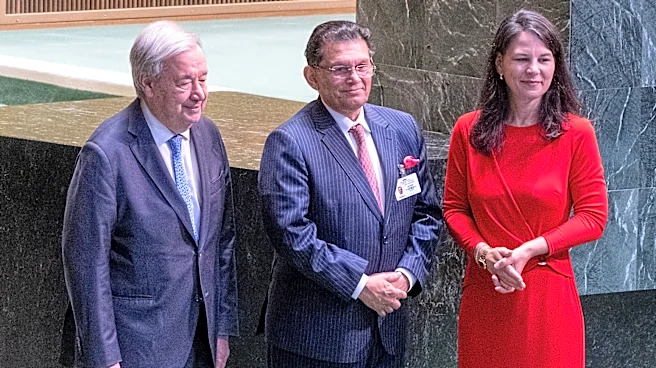
Portugal and Austria have successfully secured seats on the United Nations Security Council, defeating Germany in a competitive election. The election involved intense campaigning for the 10 rotating seats on the 15-member council, which are designated
for different global regions. The General Assembly elects five countries annually to serve two-year terms alongside the council's five permanent members: the United States, Russia, China, Britain, and France. In another contested race, Kyrgyzstan defeated the Philippines to join the council for the first time. Zimbabwe and Trinidad and Tobago were elected unopposed. The Security Council is tasked with ensuring international peace and security, but has faced challenges due to veto powers held by permanent members, particularly in conflicts involving Ukraine, Gaza, and Iran. Efforts to reform the council to better reflect current geopolitical realities have been ongoing but unsuccessful.
Why It's Important?
The election of Portugal and Austria to the U.N. Security Council is significant as it reflects shifting alliances and geopolitical strategies within the international community. Germany's defeat, despite its economic influence and previous terms on the council, highlights the complex dynamics at play, including Russia's opposition due to Germany's support for Ukraine. The inclusion of Kyrgyzstan marks a new representation for Central Asia, potentially influencing discussions on regional issues. The Security Council's ability to address global conflicts is often hindered by the veto power of permanent members, underscoring the need for reform to enhance its effectiveness in maintaining international peace and security.
What's Next?
The newly elected members, including Portugal, Austria, and Kyrgyzstan, will assume their roles on January 1, replacing Denmark, Greece, Pakistan, Panama, and Somalia. As they prepare to take their seats, these countries may focus on building alliances and advocating for their regional interests within the council. The ongoing efforts to reform the Security Council could gain momentum, with discussions potentially addressing the veto power and representation to better align with contemporary global challenges. The new members will likely engage in diplomatic efforts to navigate the council's complex dynamics and contribute to international peacekeeping initiatives.