


What's Happening?
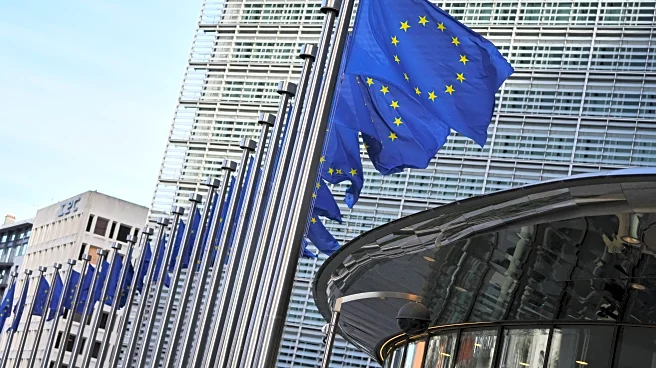
The European Parliament has voted to refer the EU-Mercosur trade agreement to the European Court of Justice (ECJ) for a legal opinion, potentially delaying the ratification of the agreement for over a year. The decision was made in a closely split vote,
with 334 Members of the European Parliament (MEPs) supporting the referral and 324 opposing it. The agreement, which involves the Mercosur bloc of Brazil, Argentina, Paraguay, and Uruguay, aims to create a large free trade zone by eliminating tariffs on a significant portion of goods traded between the EU and Mercosur countries. Despite the European Commission's support for the agreement, citing benefits for European industries and access to raw materials, the referral reflects concerns over the agreement's impact on European farmers and the need for fair trade practices.
Why It's Important?
The referral to the ECJ introduces significant uncertainty for businesses and exporters who were anticipating the benefits of the trade agreement. The delay could last 18 to 20 months, affecting sectors such as wine, dairy, and spirits, which were expected to gain from the agreement. The decision highlights the tension between promoting free trade and protecting domestic industries, particularly in agriculture. European farmers have expressed concerns about the agreement's potential to undermine local standards and competitiveness. The delay also comes at a time when the EU is seeking to diversify its trade relations amid geopolitical and economic challenges, making the swift implementation of such agreements crucial for economic stability and growth.
What's Next?
The European Court of Justice will now review the legal basis of the EU-Mercosur trade agreement, a process expected to take over a year. During this period, the European Parliament will continue to scrutinize the agreement's texts but will not proceed to a final vote until the court delivers its opinion. The outcome of the court's review will determine whether the European Parliament grants or withholds consent for the agreement. Stakeholders, including political leaders and industry groups, are likely to continue lobbying for their interests, with some advocating for the agreement's swift implementation and others calling for stronger safeguards for sensitive sectors.