






What's Happening?
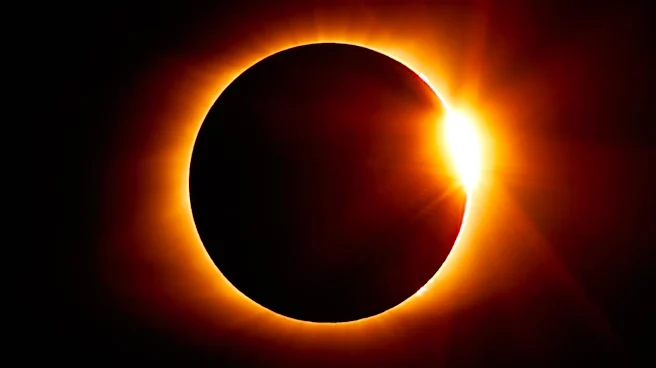
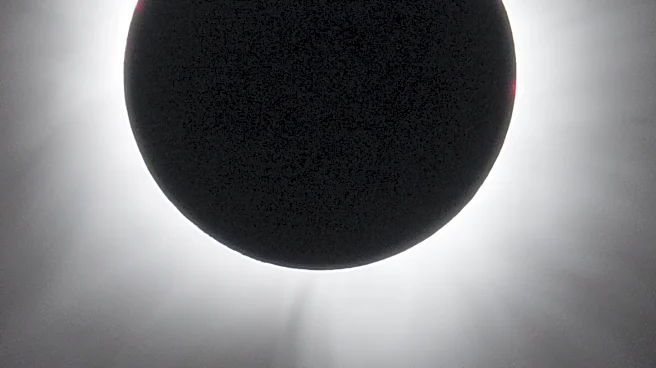
On July 28, 1851, Johann Julius Friedrich Berkowski, a Prussian daguerreotypist, successfully captured the first-ever photograph of a total solar eclipse. Using a 6-centimeter telescope, Berkowski recorded an 84-second exposure immediately after the moon
completely covered the sun. This achievement marked a significant advancement in astronomical photography, allowing scientists to study the solar event and the sun's corona in unprecedented detail. Prior attempts to photograph solar eclipses often failed due to exposure issues, but Berkowski's daguerreotype provided a clear image of the sun's outer atmosphere, paving the way for future scientific exploration.
Why It's Important?
Berkowski's successful capture of a total solar eclipse was a groundbreaking moment in the field of astronomy, enabling detailed study of the sun's corona and enhancing understanding of solar phenomena. This milestone in photographic technology made solar eclipses more accessible to scientists and the public, fostering interest in astronomy and space exploration. The ability to document such events visually has since evolved with digital cameras and smartphones, democratizing access to astronomical observations. Berkowski's work laid the foundation for modern eclipse photography, contributing to scientific advancements and public engagement with space science.