


What's Happening?
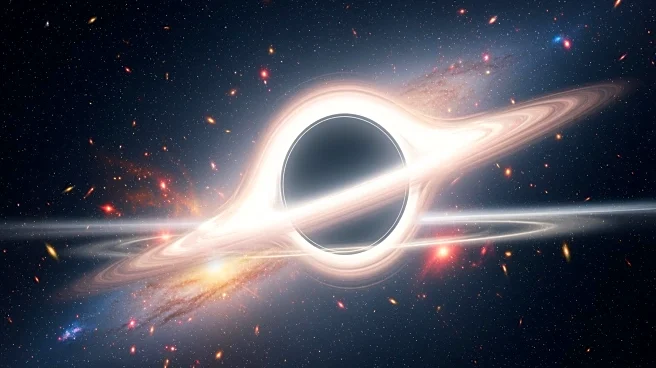
Astronomers using the James Webb Space Telescope (JWST) have confirmed the existence of the first known runaway supermassive black hole. This black hole, with a mass approximately 10 million times that of the sun, is moving at a speed of about 1,000 kilometers
per second, allowing it to escape the gravitational pull of its host galaxy. The black hole is located in a system known as the Cosmic Owl, which consists of a pair of interacting ring galaxies situated around 9 billion light-years from Earth. The discovery corroborates earlier observations made by the Hubble Space Telescope, which identified a long, narrow streak of gas and stars that was difficult to explain. JWST data revealed shock waves in the gas at the leading edge of this streak, with the black hole positioned at its tip. Theories suggest that the black hole was ejected during a violent event, possibly following a merger of two supermassive black holes, resulting in a gravitational-wave recoil.
Why It's Important?
The confirmation of a runaway supermassive black hole has significant implications for our understanding of galaxy evolution and the dynamics of black holes. This discovery provides evidence for the theoretical predictions that such ejections can occur, offering new insights into the forces required to dislodge a massive black hole from its galaxy. The black hole's journey through space is creating a trail of gas where new stars are forming, highlighting a previously unknown process of stellar birth far from a galaxy's center. This finding could lead to a reevaluation of how galaxies evolve and interact over time. Additionally, the ability to identify runaway black holes using JWST's capabilities opens up new avenues for research, potentially leading to the discovery of more such phenomena in the universe.
What's Next?
Future missions, such as the Roman Space Telescope and Euclid, are expected to search for similar thin streaks of gas and stars across large sections of the sky. These missions could help astronomers locate more runaway black holes, further enhancing our understanding of their frequency and impact on galaxy dynamics. The escaped black hole is unlikely to significantly affect its original galaxy, but its interaction with other galaxies could lead to intense shocks and the formation of new stars. Continued observations and research will be crucial in unraveling the complexities of these cosmic events and their implications for the broader universe.