




What's Happening?
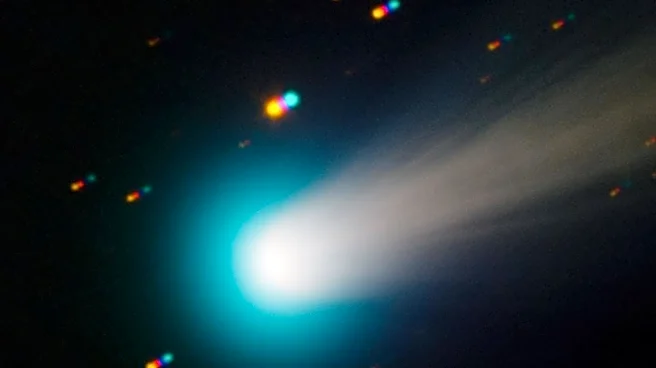
Comet 220P/McNaught underwent two significant increases in brightness during the summer, attributed to the ejection of gas and dust from its surface as it was heated by the Sun. The first outburst occurred at the end of May 2026, where its apparent magnitude
changed from +17.39 to +11.05 in less than 14 hours, eventually reaching +8.23 by June 2. This made the comet briefly observable with 10x50 binoculars from dark locations. A second outburst took place at the end of July, with its brightness increasing from magnitude +14 on July 28 to +6.1 on August 6. Researchers link these phenomena to the sublimation of ices, such as water, carbon dioxide, and nitrogen, which convert directly into gas. The pressure from the escaping gas causes the destruction of parts of the comet's dusty crust, releasing billions of pounds of cometary dust into space and forming a brighter coma around its nucleus.
Why It's Important?
These outbursts from Comet 220P/McNaught provide valuable data for astronomers studying cometary composition and behavior. The rapid increase in brightness and the ejection of vast amounts of dust offer insights into the internal structure of comets and the processes that drive their activity. Understanding these mechanisms is crucial for comprehending the early solar system, as comets are considered remnants from its formation. The observations contribute to refining models of cometary evolution and predicting future cometary activity. For the scientific community, such events are rare opportunities to study these icy bodies up close, albeit remotely, and to test existing theories about their physical and chemical properties.
What's Next?
Comet 220P/McNaught, discovered in 2004, is a short-period Jupiter-family comet with an orbital period of approximately five and a half years. After its closest approach to Earth on October 12, it is now fading and moving towards the most distant point of its orbit. Researchers will continue to analyze the data collected during these outbursts, with initial findings published on November 3 in the journal Monthly Notices of the Royal Astronomical Society. Future observations will focus on monitoring the comet's long-term behavior and comparing its activity in subsequent orbits to better understand the factors influencing its brightness and dust ejections. This ongoing research will contribute to a broader understanding of cometary science.
Beyond the Headlines
The study of comets like 220P/McNaught extends beyond mere observation; it delves into the fundamental questions about the origins of water and organic molecules on Earth. Comets are often referred to as 'dirty snowballs' and are thought to have delivered significant amounts of these crucial ingredients to our planet early in its history. Each outburst, each release of material, offers a glimpse into these ancient building blocks. The ability to observe and analyze these events, even from millions of miles away, underscores the advanced capabilities of modern astronomy and its role in unraveling the mysteries of the universe and our place within it.