
What's Happening?
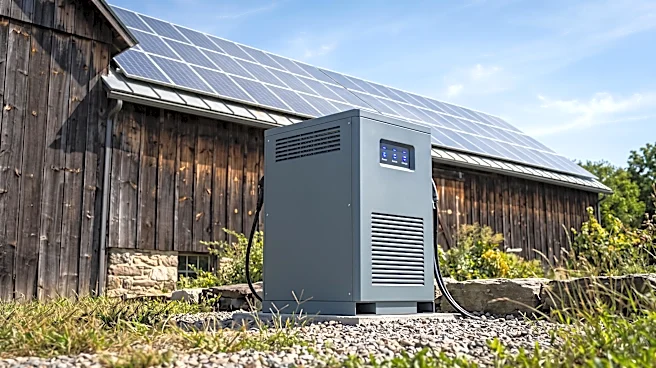
The city of Issaquah, Washington, is moving forward with plans to install a 60 kWh sodium-ion battery system at Pickering Barn, designated as a community resilience hub. This battery will integrate with the
barn's existing 64.9 kW-DC solar array, enabling the facility to power critical loads during grid outages. Emerald Battery Labs, a Seattle-based manufacturer, is developing the battery system. The project is partially supported by a $671,000 grant from TransAlta Centralia Generation LLC. This initiative is part of a phased upgrade for Pickering Barn, which previously saw the installation of heat pumps in 2025 and the solar array in 2026. The goal is to reduce energy costs, increase renewable energy use, and provide a model for other public buildings to enhance community resilience. The battery system is currently in the design phase, with certification, permitting, procurement, installation, and commissioning still required before it becomes operational.
Why It's Important?
This project is significant as it demonstrates a practical application of sodium-ion battery technology for community resilience, offering an alternative to more common lithium-ion solutions. By pairing solar power with battery storage, Issaquah aims to create a self-sufficient facility capable of providing essential services during emergencies, such as warming or cooling centers, device charging, and community support. This initiative could serve as a blueprint for other municipalities looking to enhance their energy independence and emergency preparedness. The use of sodium-ion batteries, which utilize more abundant materials than lithium, could also contribute to diversifying the energy storage supply chain and potentially reducing costs. Furthermore, the project highlights the growing trend of integrating renewable energy with storage to create microgrids, improving grid stability and local energy security.
What's Next?
The immediate next steps for the Pickering Barn battery project involve Emerald Battery Labs completing the design and securing necessary certifications, including UL 1973 for batteries, UL 9540 for the complete energy storage system, and UL 9540A for thermal-runaway fire propagation testing. Following certification, the city of Issaquah will proceed with municipal procurement and permitting processes. After these administrative hurdles, the physical installation, controls integration, and commissioning of the battery system will take place. The city has yet to release specific details regarding the battery's power rating (kW) or a definitive list of critical loads it will support, which are crucial for understanding the system's full operational capacity and expected outage duration. These details will be vital for emergency planners and for other communities considering similar projects.
Beyond the Headlines
The Issaquah project extends beyond a simple energy upgrade; it represents a strategic move towards decentralized energy infrastructure and enhanced community resilience in the face of potential grid vulnerabilities, such as extreme weather events or other disruptions. The choice of sodium-ion technology also signals a broader industry interest in exploring diverse battery chemistries that offer advantages in terms of material availability, cost, and safety characteristics, particularly thermal stability. This could accelerate the adoption of alternative battery technologies in stationary storage applications. Furthermore, by retrofitting a historic public building like Pickering Barn, the project demonstrates how existing community assets can be transformed into modern, sustainable resilience hubs, blending historical preservation with cutting-edge energy solutions. This approach could inspire similar initiatives in other communities looking to leverage their existing infrastructure for future challenges.