



What's Happening?
Researchers have developed a new type of light sail using photonic crystals, which could revolutionize space propulsion. Traditional space missions rely on chemical rockets that require fuel, increasing spacecraft mass and limiting speed and travel distance.
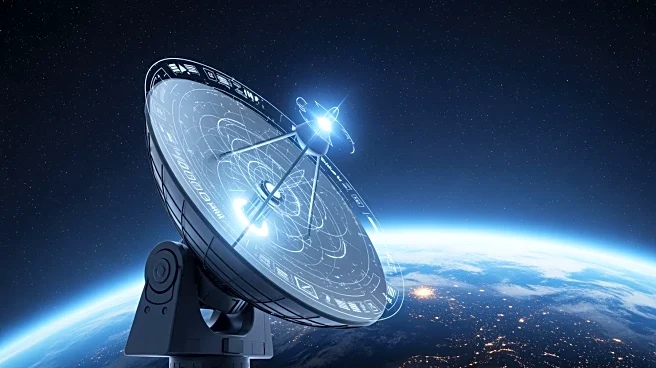
Light sails, driven by radiation pressure from powerful lasers, offer an alternative by enabling continuous acceleration without onboard propellant. The new design incorporates a nanoscale pattern of germanium pillars, air holes, and a polymer matrix, creating a photonic bandgap structure optimized for propulsion-specific reflectivity. This configuration allows high reflectivity at the propulsion wavelength while remaining transparent to other solar radiation. The researchers have fabricated proof-of-concept membranes using advanced nanolithography techniques, achieving approximately 90% reflectivity at a wavelength of 1.2 micrometers.
Why It's Important?
The development of photonic crystal light sails represents a significant advancement in space propulsion technology. By eliminating the need for onboard fuel, these sails could drastically reduce spacecraft mass, enabling faster and more efficient travel across the solar system. This technology could support lightweight probes for interplanetary exploration, potentially reducing mission costs and expanding the scope of space exploration. The ability to fabricate multi-dielectric photonic crystal structures with controlled nanoscale features opens new possibilities for scalable and lightweight propulsion systems. This innovation could serve as a foundation for future interplanetary missions, providing a pathway to experimentally validated devices for laser-driven propulsion.
What's Next?
Further research and development are needed to transition photonic crystal light sails from theoretical design to operational deployment. Researchers must conduct additional studies to refine the design and fabrication processes, ensuring the sails can withstand the harsh conditions of space travel. The next steps involve testing the sails in real-world scenarios to validate their performance and scalability. If successful, this technology could pave the way for new interplanetary exploration missions, potentially transforming how spacecraft are designed and operated. Collaboration with space agencies and industry partners will be crucial to advancing this technology and integrating it into future missions.
Beyond the Headlines
The introduction of photonic crystal light sails could have broader implications for the space industry, including ethical and environmental considerations. By reducing the reliance on chemical rockets, this technology could decrease the environmental impact of space launches, contributing to more sustainable exploration practices. Additionally, the development of lightweight propulsion systems may influence the design of future spacecraft, leading to innovations in materials science and engineering. As the technology matures, it could also inspire new educational and research opportunities, fostering collaboration between academia and industry to explore the potential of photonic propulsion.