





What's Happening?
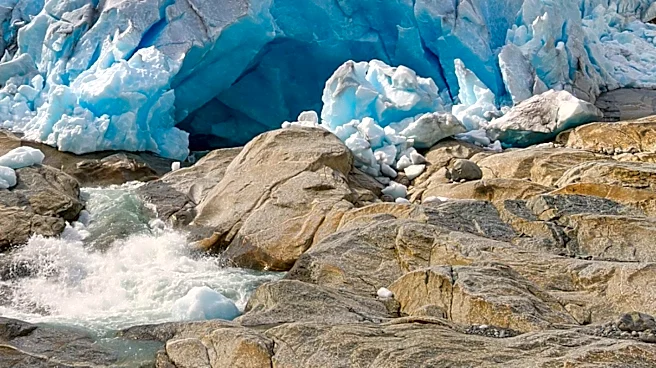
A new study, currently undergoing peer review, indicates that the surge of cold meltwater from Greenland into the North Atlantic is significantly altering ocean temperatures and shifting the jet stream. This phenomenon is contributing to more frequent
and intense heatwaves across Western Europe and the Mediterranean. Marilena Oltmanns, from the UK’s National Oceanography Centre and one of the study's authors, states that this newly identified 'atmospheric bridge' played a major role in the unprecedented heatwaves experienced this summer. The research suggests that as Greenland's ice loss accelerates, Europe could face heatwaves that are more extreme than current climate models predict. Over the past three decades, high-pressure ridges, which lead to sunny skies and extreme heat, have been forming more frequently over Europe due to waviness in the jet stream. This allows warm air from the central Atlantic and Sahara desert to flow into these ridges, exacerbating heat conditions. The study links these ridges to a cascade of climate events originating from Greenland, where an average of 81 billion tonnes more meltwater rushes off the ice sheet in the summer before years of extensive ridging.
Why It's Important?
The findings of this study are crucial because they highlight a previously underestimated mechanism driving European heatwaves, suggesting that existing climate models may not fully capture the severity of future extreme weather events. The intensification of heatwaves has profound implications for public health, as evidenced by the 2003 heatwave that resulted in 70,000 deaths. Economically, prolonged heat and drought conditions can push power grids to breaking points, disrupt transportation, and negatively impact agriculture and water resources. The altered jet stream patterns could also lead to other extreme weather phenomena, such as intense thunderstorms and flooding, increasing overall climate variability. For the U.S., while the study focuses on Europe, it underscores the interconnectedness of global climate systems and the potential for similar, or even more severe, impacts from climate change. Understanding these 'atmospheric bridges' is vital for developing more accurate climate predictions and effective mitigation strategies worldwide.
What's Next?
The ongoing research suggests that Europe should prepare for even more extreme heatwaves and droughts in the coming years, particularly in the Mediterranean region. Climate models will need to be updated to incorporate this newly identified 'atmospheric bridge' and its effects on the jet stream to provide more accurate future climate projections. Policymakers and urban planners will likely need to implement more robust heat mitigation strategies, including infrastructure adjustments, public health advisories, and emergency response plans. Further research will be necessary to fully understand the long-term implications of Greenland's meltwater on global weather patterns and to explore potential feedback loops that could accelerate these changes. The study also implies a need for increased international collaboration on climate research and adaptation efforts, as the impacts of a warming Arctic are felt globally.
Beyond the Headlines
This study reveals a deeper, more complex interaction within the Earth's climate system than previously understood, linking Arctic ice melt directly to mid-latitude weather extremes. The concept of an 'atmospheric bridge' highlights how localized environmental changes, such as the melting of the Greenland ice sheet, can have far-reaching and significant consequences across continents. This challenges the notion that climate impacts are always gradual and predictable, emphasizing the potential for abrupt shifts in weather patterns. Ethically, it underscores the urgency of addressing climate change, as the consequences are not just abstract future scenarios but are already manifesting in severe and life-threatening ways. The underestimation of these effects in current climate models also raises questions about the adequacy of existing climate policies and the need for a more proactive and adaptive approach to environmental governance.