




What's Happening?
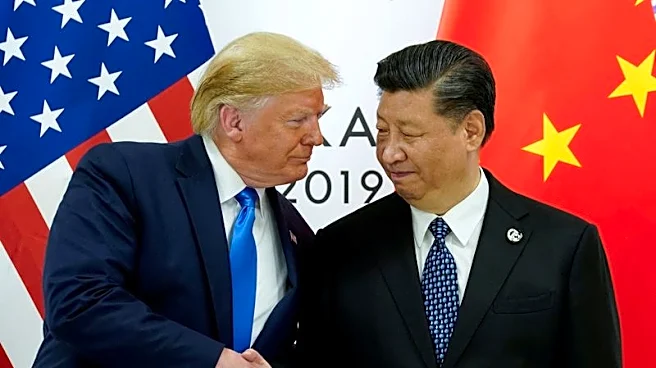
The global scientific community is experiencing shifts due to geopolitical tensions, particularly between the U.S. and China. The U.S. has been leading efforts to economically decouple from China, affecting scientific collaborations. This decoupling is reminiscent
of Cold War-era isolation, where research was divided between the Western and Eastern blocs. Despite these challenges, some institutions continue to foster international collaboration. For instance, the Simons Foundation is funding new research centers in Ukraine, and Germany's Max Planck Society has opened centers in Beijing. Historically, periods of isolation have sometimes led to scientific advancements, as seen in China during the 1960s. However, the current political climate poses risks to the free exchange of ideas and collaborative research.
Why It's Important?
The decoupling of U.S. and China in scientific research has significant implications for global innovation and technological advancement. The restriction on collaborations could slow down progress in critical areas such as quantum computing and artificial intelligence, which are vital for national security and economic growth. The U.S.'s scrutiny of collaborations with Chinese scientists may deter joint research efforts, impacting the global scientific community's ability to address complex challenges like climate change and pandemics. The situation underscores the tension between national security priorities and the inherently international nature of scientific research, which thrives on open collaboration and exchange of ideas.
Beyond the Headlines
The geopolitical tensions affecting scientific collaboration highlight broader ethical and cultural challenges. The scientific community is built on trust and openness, which are at odds with isolationist policies driven by suspicion. The decoupling could lead to a fragmented research landscape, where national interests overshadow global cooperation. This shift may also influence educational exchanges, as Western universities with campuses in Asia might face increased scrutiny. The long-term impact could be a realignment of global research networks, with countries seeking new partnerships to circumvent political barriers. The situation calls for a reevaluation of how scientific diplomacy can be leveraged to bridge divides and foster mutual understanding.