






What's Happening?
The Tyrannosaurus rex skeleton known as 'Stan,' discovered in South Dakota in 1987 by amateur fossil hunter Stan Sacrison, has found a permanent home at the Natural History Museum Abu Dhabi. Initially misidentified as a Triceratops, the bones were correctly
identified as a T. rex in 1992 by experts from the Black Hills Institute of Geological Research. After a meticulous excavation and assembly process involving over 30,000 hours of manual work, Stan became one of the most complete T. rex skeletons ever found, measuring 11.7 meters long with a particularly important skull. In October 2020, Stan was auctioned by Christie's in New York for $31.8 million, significantly exceeding its pre-sale estimate. The identity of the buyer was revealed in March 2022, confirming that the fossil was acquired for the new museum.
Why It's Important?
The sale of 'Stan' for a record-breaking sum highlights the increasing commercial value of significant paleontological discoveries, raising concerns among paleontologists about the accessibility of such specimens for scientific research. The move to Abu Dhabi ensures that 'Stan' remains publicly accessible and available for study, addressing initial fears that it might disappear into a private collection. This acquisition also positions the Natural History Museum Abu Dhabi as a major global institution for natural history, attracting international attention and potentially boosting tourism and scientific engagement in the region. The display of 'Stan' in a dynamic scene, depicting a clash with another T. rex, offers a unique educational experience, illustrating the violent interactions of these ancient predators.
What's Next?
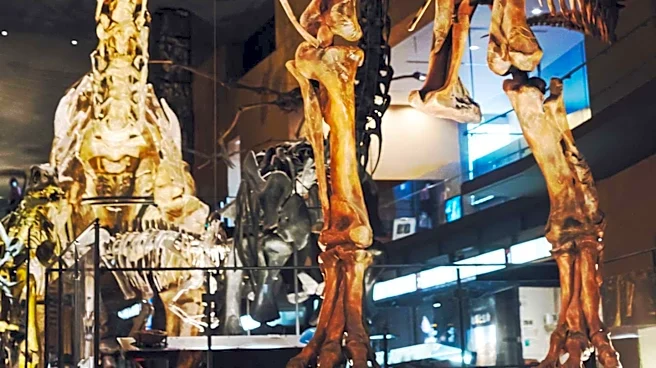
The Natural History Museum Abu Dhabi opened in November 2025, with 'Stan' serving as a central attraction. The museum's innovative display, which shows 'Stan' in a dramatic scene with another T. rex, aims to engage visitors and provide insights into the dinosaur's life and injuries. The presence of such a significant fossil is expected to draw researchers and the public, fostering further scientific study and educational programs. The record-breaking sale of 'Stan' and another T. rex, 'Gus,' in 2026 for approximately $50.1 million, indicates a continuing trend of high-value dinosaur fossil auctions, which may influence future discoveries and their commercialization.
Beyond the Headlines
The journey of 'Stan' from a South Dakota discovery to a centerpiece in an Abu Dhabi museum underscores the global nature of scientific heritage and its intersection with commerce and cultural diplomacy. The debate surrounding the private ownership versus public accessibility of such fossils raises ethical questions about the stewardship of natural history. While the high prices can fund further research and conservation efforts, they also risk making invaluable scientific resources inaccessible. 'Stan' serves as a powerful reminder that fossils are not just ancient remnants but crucial keys to understanding Earth's past, capable of inspiring awe and scientific inquiry across continents.