






What's Happening?
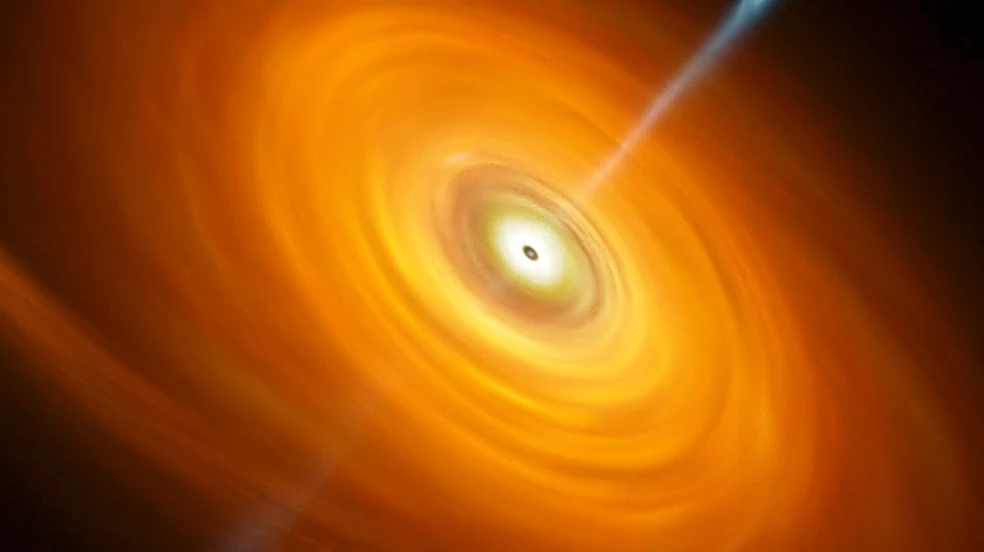
New theoretical calculations by researchers associated with the University of Southern Denmark and collaborating institutions are exploring the possibility of a black hole splitting into two. While black holes are known to merge, the reverse process of splitting faces
significant thermodynamic obstacles. For an ordinary nonrotating black hole, splitting would reduce its total entropy, making the process unfavorable under standard thermodynamic rules. However, the study, published in Physical Review D, investigates whether rapid rotation could alter this calculation. A spinning black hole stores energy in its rotation, which could affect the conditions for possible final states. The analysis suggests that splitting might become thermodynamically possible under certain circumstances, specifically for black holes rotating extremely close to their theoretical maximum. Even then, the research does not confirm that a real black hole would fragment, and no such event has ever been observed. The study also considered more unusual models of gravity involving extra spatial dimensions, where splitting could sometimes be more favorable, particularly when the resulting objects have very different sizes. These remain theoretical possibilities rather than confirmed descriptions of the universe.
Why It's Important?
This research is important because it pushes the boundaries of our understanding of fundamental physics and the nature of black holes. While the splitting of a black hole has not been observed, exploring its theoretical possibility helps scientists test the limits of established physical laws, particularly thermodynamics and gravity. If such an event were ever confirmed, it would necessitate a significant re-evaluation of current astrophysical models and could lead to new insights into the extreme conditions of the universe. The study's focus on extremely fast-spinning black holes and alternative gravity models highlights areas where our current understanding might be incomplete. It also underscores the ongoing scientific endeavor to reconcile theoretical predictions with observational data, even in the absence of direct evidence. The implications extend to how we perceive the evolution of cosmic structures and the fundamental forces governing them, potentially opening new avenues for research in theoretical physics and cosmology.
What's Next?
The immediate next steps involve further theoretical exploration and potentially indirect investigations. The study discusses how fragmentation might be investigated indirectly through signals from tiny black-hole fragments, though such searches would be challenging and dependent on the behavior of gravity in extreme conditions. Researchers will likely continue to refine their theoretical models, perhaps incorporating more complex scenarios or exploring additional parameters that could influence black hole stability. While direct observation of a black hole splitting remains elusive, future advancements in astronomical observation technologies could potentially detect subtle signatures that align with these theoretical predictions. The work also encourages continued research into alternative models of gravity and extra spatial dimensions, as these frameworks offer potential conditions under which such an event might be more plausible. The primary focus will remain on understanding the restrictions that make splitting unlikely and where those restrictions might fail, thereby deepening our knowledge of black holes and the universe.
Beyond the Headlines
Beyond the immediate scientific implications, this research touches upon the philosophical underpinnings of scientific inquiry itself. It exemplifies how theoretical physics often explores scenarios that seem improbable or even impossible based on current observations, yet these explorations are crucial for advancing knowledge. By questioning established norms, such as the thermodynamic favorability of black hole mergers over splitting, scientists can identify potential gaps or limitations in existing theories. The concept of a black hole splitting, while currently theoretical, challenges our intuitive understanding of cosmic evolution and the stability of extreme gravitational phenomena. It also highlights the role of mathematical modeling and theoretical calculations in guiding future observational efforts, even if those observations are decades away. This kind of fundamental research, even without immediate practical applications, contributes to humanity's broader quest to comprehend the universe and our place within it, pushing the boundaries of what is considered possible in the cosmos.