



What's Happening?
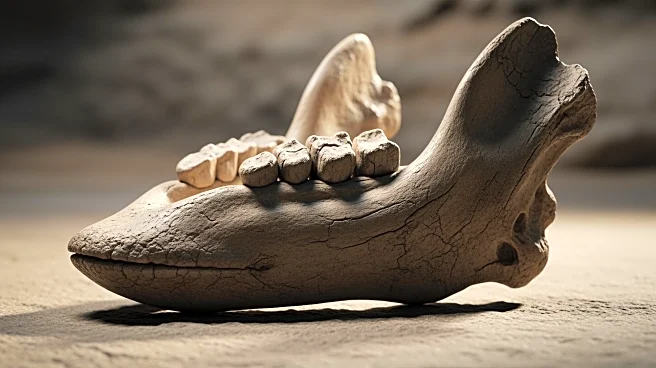
A newly discovered 2.6-million-year-old partial lower jaw from Ethiopia's Afar region has expanded the known range of the Paranthropus genus by about 1,000 kilometers north of previous records. This fossil, catalogued as MLP-3000, was found in the Mille-Logya
research area and is the first known Paranthropus fossil from this region. The discovery challenges previous notions of Paranthropus as a narrowly confined 'nutcracker' specialist, suggesting instead that it was a versatile hominin capable of living across a wider set of habitats, similar to early Homo species.
Why It's Important?
This discovery is crucial as it forces a reevaluation of the ecological and evolutionary models of early hominins. The presence of Paranthropus in a new region suggests that it was not limited by dietary specialization or competition, as previously thought. This finding underscores the adaptability of Paranthropus and its potential to exploit diverse environments, which could have significant implications for understanding the evolutionary pathways of early human ancestors. It also highlights the importance of continued fossil exploration in regions like Afar, which have been central to paleoanthropological research.