
What's Happening?
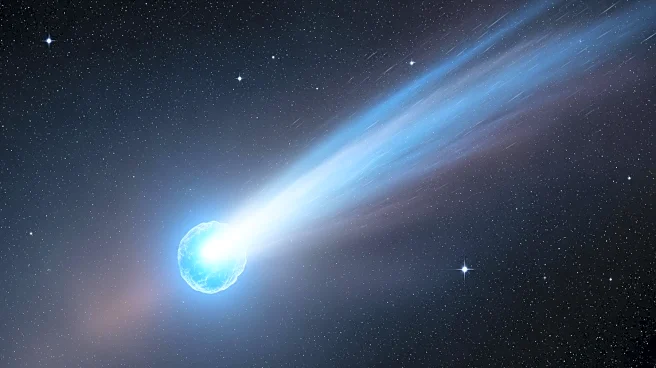
Comet 3I/ATLAS, designated C/2025 N1 (ATLAS), is the third confirmed interstellar object to pass through our solar system. Recently, it has been observed with a faint green glow, attributed to diatomic
carbon in its coma. This comet, discovered by the NASA-funded ATLAS survey telescope, is on a hyperbolic trajectory, indicating it will not be captured by the Sun's gravity and will return to interstellar space. On December 19, 2025, it will make its closest approach to Earth, at a safe distance of about 1.8 astronomical units, or 270 million kilometers. The comet's interaction with the solar wind is being studied through X-ray observations by missions such as Japan's XRISM and ESA's XMM-Newton, providing insights into its composition and behavior.
Why It's Important?
The passage of Comet 3I/ATLAS offers a unique opportunity for scientists to study an interstellar object in detail. Its green glow and the presence of diatomic carbon provide clues about its chemical composition, which may differ from typical solar system comets. The data collected could enhance our understanding of the building blocks of planetary systems beyond our own. Additionally, the comet's safe distance from Earth alleviates any concerns of potential impact, allowing for focused scientific observation without public alarm. The insights gained from this comet could inform future studies of interstellar objects and their role in the broader cosmic environment.
What's Next?
As Comet 3I/ATLAS continues its journey, scientists will monitor it for any changes, such as outbursts triggered by thermal lag as the Sun's heat penetrates deeper into the comet. The ongoing multiwavelength observations, including X-ray studies, will refine our understanding of its gas and dust properties. This data will contribute to a comprehensive analysis of the comet's interaction with the solar wind. The scientific community is treating this as a once-in-a-generation opportunity to study an interstellar visitor, with findings expected to be published in the coming months.