




What's Happening?
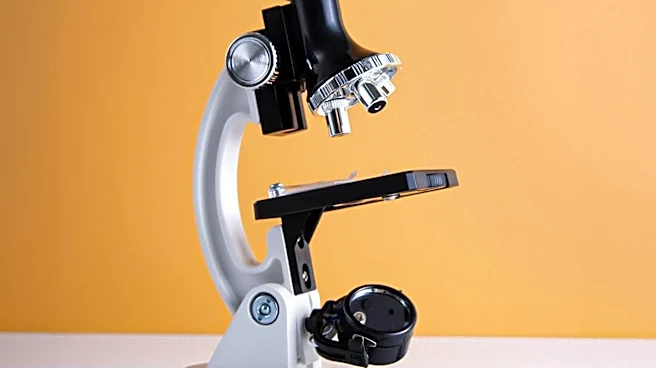
Robert Hooke, a prominent 17th-century scientist, made significant contributions across various scientific disciplines, including microscopy, biology, physics, astronomy, and geology. He is widely recognized for his 1665 book 'Micrographia,' which featured
detailed illustrations of microscopic observations and introduced the term 'cell' to describe the structures he observed in cork. Hooke also formulated Hooke's law, which describes the relationship between force and extension in elastic materials, a principle still fundamental in physics and engineering. His work extended to improving scientific instruments, studying fossils as evidence of ancient life, and investigating geological processes like earthquakes. As Curator of Experiments for the Royal Society, Hooke conducted numerous demonstrations, showcasing his broad experimental approach and practical skills in instrument making and architecture, particularly during the rebuilding of London after the Great Fire.
Why It's Important?
Robert Hooke's work laid foundational groundwork for modern science by demonstrating the power of observation through instruments, particularly the microscope. His detailed illustrations in 'Micrographia' transformed scientific understanding by revealing a hidden world of microscopic structures, thereby establishing microscopy as a crucial scientific method. The introduction of the term 'cell' became a cornerstone of biological terminology, even though modern cell theory developed later. Hooke's law remains a vital concept in physics and engineering, essential for understanding material properties and designing mechanical systems. His investigations into fossils and geological changes were pioneering, challenging prevailing views and contributing to the understanding of Earth's history and the evolution of life. His multidisciplinary approach and emphasis on experimental evidence were instrumental in shaping the scientific method and influencing subsequent generations of scientists.
What's Next?
While Robert Hooke's direct scientific work is historical, its legacy continues to influence contemporary research and education. Future developments will involve continued exploration and refinement of the scientific principles he established, such as Hooke's law, in advanced materials science and engineering. In biology, the understanding of cellular structures, first conceptualized by Hooke, has evolved into complex fields like molecular biology and genomics, which will continue to expand. Historians of science will likely continue to re-evaluate Hooke's contributions and his complex relationships with contemporaries like Isaac Newton, ensuring his rightful place in the scientific canon. Educational curricula will continue to feature his discoveries as fundamental examples of scientific inquiry and the impact of technological advancements on understanding the natural world. The ongoing preservation and study of historical scientific instruments, some of which Hooke designed or improved, will also provide insights into the evolution of scientific practice.
Beyond the Headlines
Robert Hooke's story extends beyond his individual discoveries, highlighting the ethical and philosophical dimensions of scientific progress. His disputes over scientific priority, particularly with Isaac Newton, underscore the competitive nature of scientific advancement and the importance of attribution. This historical context serves as a reminder of the human element in scientific endeavors, where personal rivalries can sometimes overshadow collaborative spirit. Furthermore, Hooke's ability to bridge theoretical science with practical applications, such as his architectural work in London, illustrates the societal impact of scientific knowledge. His legacy encourages a holistic view of science, where observation, experimentation, and practical application are intertwined. It also prompts reflection on how scientific language and terminology, like the word 'cell,' become embedded in our understanding of the world, shaping how we perceive and categorize reality.