



What's Happening?
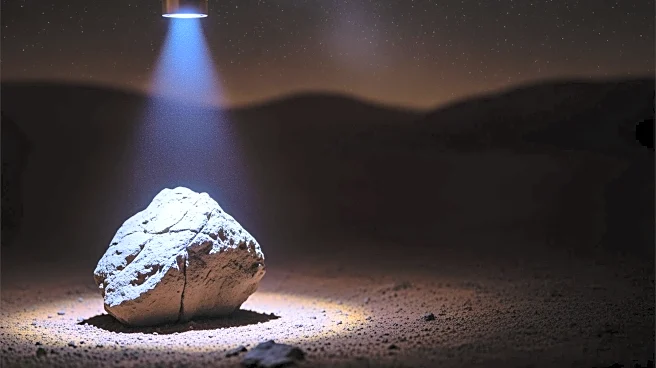
NASA's Perseverance rover has discovered white kaolinite rocks on Mars, specifically in the Jezero crater. These rocks are significant because they are composed of kaolinite clays, which are aluminum-rich and rare. On Earth, such clays typically form
after millions of years of warm, wet rainfall, suggesting that Mars may have experienced long periods of rain in its past. This discovery challenges previous notions of Mars as a predominantly dry and frozen planet. The rocks were identified using Perseverance's advanced SuperCam and Mastcam Z instruments, which conducted detailed chemical analyses. These analyses compared the Martian clays with similar samples from Earth, providing insights into past water activity and environmental conditions that could have supported ancient microbial life.
Why It's Important?
The discovery of kaolinite rocks on Mars is crucial as it reshapes the understanding of the planet's climate history and its potential habitability. If Mars experienced long periods of rainfall, it could have had conditions suitable for life to emerge. This finding could influence future Mars exploration missions, focusing on areas where water might have been present. The presence of these clays suggests that Mars had a more dynamic climate in the past, which could have included sustained wet conditions. This challenges the long-held view of Mars as a barren, dry world and opens up new possibilities for understanding the planet's geological and climatic evolution.