



What's Happening?
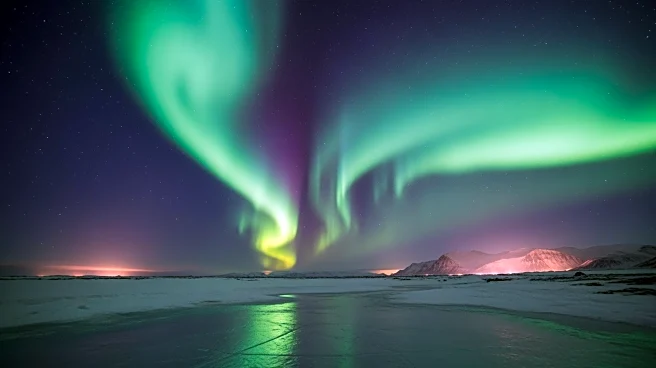
In February 2026, a minor geomagnetic storm led to a spectacular display of the aurora borealis over Iceland and Canada. The Visible Infrared Imaging Radiometer Suite (VIIRS) on the Suomi NPP satellite captured images of the northern lights on February 16.
The auroras, visible in various colors to observers on the ground, were detected in grayscale by the satellite. The NOAA Space Weather Prediction Center reported a G1 geomagnetic storm, which later intensified to a G2 storm, potentially affecting power grids and satellite operations. A NASA mission launched earlier in February aimed to study the electrical environment of auroras, contributing to a better understanding of space weather.
Why It's Important?
The observation of the aurora borealis during a geomagnetic storm highlights the ongoing need to understand space weather and its effects on Earth. Geomagnetic storms can disrupt power grids and satellite operations, posing risks to infrastructure and communication systems. The data collected by NASA's mission will aid in developing models to predict and mitigate these impacts. Understanding space weather is crucial for industries reliant on satellite technology and for ensuring the stability of power systems, particularly in high-latitude regions where auroras are more common.
What's Next?
NASA's continued research into space weather phenomena will likely lead to improved predictive models and mitigation strategies. The data from the GNEISS mission will be analyzed to create a 3D reconstruction of auroral electrical currents, enhancing scientific understanding. Future missions may focus on further exploring the interactions between solar activity and Earth's magnetic field, with potential implications for satellite design and power grid management. Stakeholders in the energy and telecommunications sectors will be particularly interested in these developments.