





What's Happening?
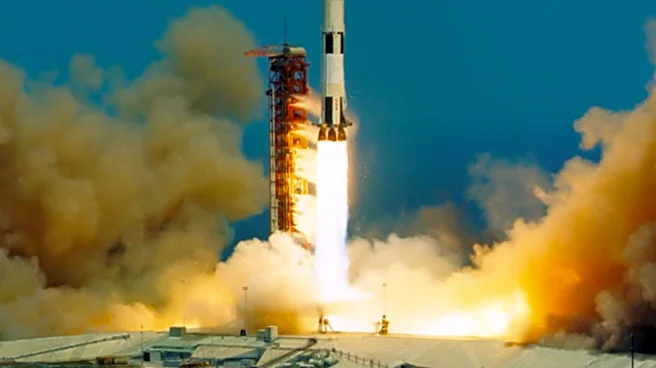
On October 11, 1968, NASA successfully launched Apollo 7, marking the first mission of the Apollo program to carry a crew into space. Astronauts Wally Schirra, Donn Eisele, and Walter Cunningham were aboard the spacecraft. This mission was critical for
rebooting the Apollo program after a tragic fire 20 months prior had killed three astronauts during a launch rehearsal. Apollo 7 served as a crucial test flight, designed to prove the functionality and safety of the Apollo spacecraft. Despite some challenges, including the crew experiencing motion sickness and a cold, and occasional arguments with mission control, the mission was deemed a success. The crew spent 11 days in space, thoroughly testing the spacecraft systems and verifying operating procedures. This successful flight paved the way for future Apollo missions, including the first lunar landing.
Why It's Important?
The Apollo 7 mission was a pivotal moment for NASA and the U.S. space program. Its success was instrumental in restoring confidence in the Apollo spacecraft and its ability to safely transport astronauts, especially after the devastating Apollo 1 fire. This mission directly addressed the urgent need to demonstrate that the fixes and overhauls made to the command module were effective and that the vehicle was space-worthy. Without Apollo 7's success, the ambitious goal set by President John F. Kennedy in 1961—to land a man on the moon and return him safely to Earth before the decade's end—would have been severely jeopardized. The mission's success not only validated the engineering and safety improvements but also provided invaluable data and experience for subsequent lunar missions, ultimately setting the stage for the historic Apollo 11 moon landing in July 1969. It underscored the resilience and determination of the U.S. space agency in overcoming significant setbacks.
What's Next?
Following the successful Apollo 7 mission, NASA proceeded with its ambitious schedule for lunar exploration. The validation of the Apollo command module's safety and functionality allowed for the planning and execution of more complex missions. The next steps involved further testing and refinement of lunar module systems and procedures, leading to Apollo 8, which orbited the Moon, and eventually Apollo 11, which achieved the first human lunar landing. The lessons learned from Apollo 7 regarding crew dynamics, spacecraft performance, and mission control interactions were integrated into future training and operational protocols. The success of Apollo 7 also had a significant impact on public and political support for the space program, ensuring continued funding and enthusiasm for the monumental task of reaching the Moon. The mission's legacy continues to influence space exploration, emphasizing rigorous testing and crew safety.
Beyond the Headlines
Beyond its immediate technical objectives, Apollo 7 carried profound psychological and political weight. The mission's success was a powerful symbol of American resilience and ingenuity in the face of tragedy, helping to heal the wounds left by the Apollo 1 fire. It demonstrated the nation's unwavering commitment to its space goals during the Cold War, reinforcing U.S. leadership in the space race. The crew's candid interactions and occasional disagreements with mission control, while challenging at the time, also highlighted the human element of space exploration, showcasing the immense pressures and personal sacrifices involved. This mission contributed to the evolving public perception of astronauts as not just heroes, but also as highly skilled professionals operating under extreme conditions. The meticulous testing and verification processes employed for Apollo 7 established a precedent for safety and reliability that continues to be a cornerstone of all human spaceflight endeavors.