







What's Happening?
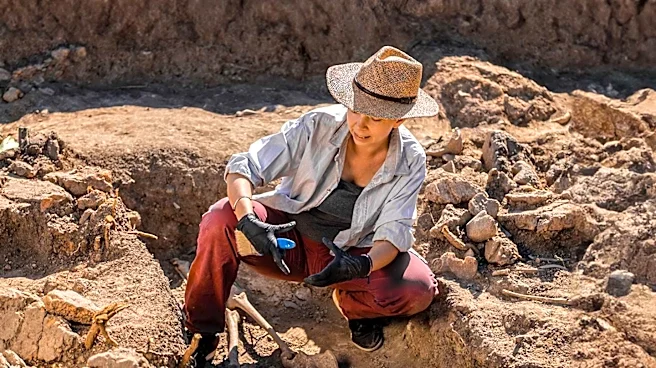
Archaeologists conducting excavations at the ancient city of Troy in Türkiye have made two significant discoveries: a 2,800-year-old bone flute and a 4,500-year-old anthropomorphic idol head. The bone flute, found in an eighth-century BC layer, marks
the first musical instrument recovered from the site in over 160 years of excavations. This discovery provides new insights into the role of music in ancient Trojan society, suggesting its use in entertainment, communal gatherings, or ceremonies. The idol head, estimated to be 4,500 years old, was found in a fire-damaged layer near the entrance to Troy II, an Early Bronze Age settlement phase. This artifact is considered rare, with only a few comparable finds in Troy's excavation history, offering valuable clues about the religious beliefs and cultural traditions of the city's early inhabitants. Both finds contribute to a deeper understanding of daily life and cultural practices in Troy over thousands of years.
Why It's Important?
These discoveries are crucial for enriching the historical and cultural understanding of one of the world's most famous ancient cities. The bone flute provides tangible evidence of musical practices during the Archaic Period, potentially coinciding with the era of Homer's epic poems, the Iliad and the Odyssey. While not directly linked to Homer, it offers a glimpse into the soundscape of that period. The idol head, on the other hand, sheds light on the early religious and symbolic traditions of Troy's inhabitants during the Early Bronze Age. Its rarity and precise archaeological context are particularly valuable for researchers studying ancient belief systems. Together, these artifacts expand the narrative of Troy beyond architectural remains and tools, offering a more nuanced picture of its social, cultural, and spiritual life. The findings underscore the ongoing importance of archaeological research at Troy for understanding ancient Mediterranean civilizations.
What's Next?
Further scientific examination of both the bone flute and the idol head is anticipated. Researchers will likely conduct detailed analyses to establish the precise characteristics of the flute, its potential uses, and its broader cultural significance. For the idol head, its location within a fire-damaged deposit will be further investigated to understand events affecting the Troy II settlement. The ongoing 2026 excavation program at the Archaeological Site of Troy, conducted under Türkiye’s Heritage for the Future project, will continue to explore different periods of Troy’s extensive history. These new discoveries are expected to guide future excavation strategies, potentially leading to more finds that can further illuminate the daily lives, artistic expressions, and spiritual practices of the ancient Trojans. The findings will also likely be presented in academic publications and public exhibitions, contributing to global knowledge of ancient history.
Beyond the Headlines
The unearthing of a musical instrument from ancient Troy carries profound implications for understanding the human experience in antiquity. Music, as a universal language, offers a unique window into the emotional and social fabric of past societies. The bone flute suggests that music was an integral part of Trojan life, potentially used in rituals, celebrations, or storytelling, much like in contemporary cultures. This discovery encourages a re-imagining of ancient Troy not just as a site of conflict, but as a vibrant cultural center. Similarly, the idol head speaks to the deeply ingrained spiritual beliefs of early human communities, highlighting the human need for meaning and connection to the divine. These artifacts transcend mere historical data; they are echoes of human creativity, belief, and daily existence, offering a more holistic and relatable view of ancient civilizations and their enduring legacy on human culture.