







What's Happening?
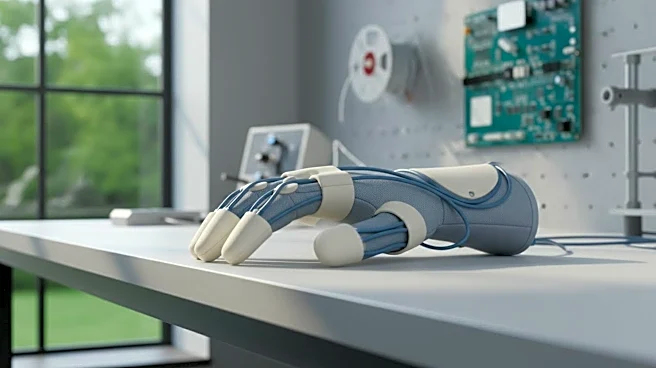
Researchers at the Technical University of Munich (TUM) have developed a soft pneumatic glove designed to restore intentional grasping in patients with severe hand paralysis. The glove utilizes a surface-EMG predictor with 97% sensitivity, along with 13
air tubes, motion sensing, and machine-learning correction to infer grasp intent. This innovative textile exoskeleton aims to prevent objects from dropping during transport, providing significant benefits to individuals with severe impairments. The development of this glove represents a focused application of biosignal decoding, soft actuation, and safety interlocks in assistive hardware, offering a promising solution for enhancing the quality of life for stroke patients and others with similar conditions.
Why It's Important?
The introduction of the soft robotic glove by TUM is a significant advancement in the field of assistive technology, particularly for individuals with hand paralysis. This development has the potential to improve the independence and daily functioning of patients, reducing the need for constant assistance. The glove's ability to accurately interpret and respond to the user's intent marks a breakthrough in the integration of machine learning and robotics in healthcare. This innovation could pave the way for further advancements in prosthetics and rehabilitation devices, offering new hope to those affected by severe motor impairments.
What's Next?
Following the successful validation of the glove with stroke patients, further clinical trials and studies are likely to be conducted to assess its long-term efficacy and safety. The research team may explore additional applications of the technology, potentially expanding its use to other types of motor impairments. Collaboration with healthcare providers and rehabilitation centers could facilitate the integration of the glove into standard treatment protocols. As the technology matures, it may become more widely available, offering a new standard of care for individuals with hand paralysis.