




What's Happening?
Professor Alain Goriely, a mathematician at the University of Oxford, has challenged the long-standing belief that the Parthenon's architectural features were designed to correct optical illusions. For over 2,000 years, scholars have praised the ancient
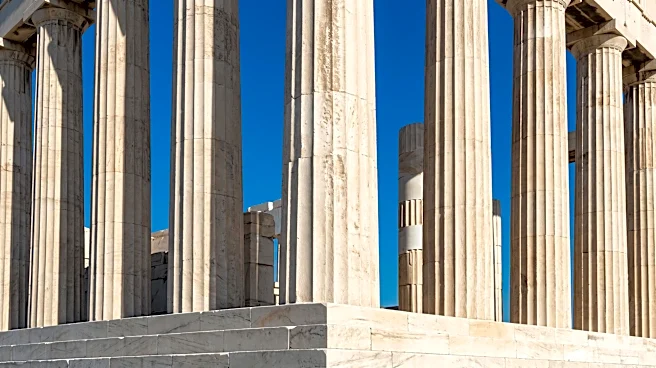
Greek architects for their supposed clever use of geometry, particularly the subtle curves in the temple's structure, which were believed to counteract visual distortions. However, after extensive investigation and mathematical modeling, Professor Goriely concluded that the optical illusions the curves were meant to fix are either non-existent or practically imperceptible. He traces the origin of this myth back to the 1st-century Roman architect Vitruvius, who wrote about the Parthenon 400 years after its construction. Vitruvius's account became an established fact in architectural literature and continues to be perpetuated even by modern AI chatbots. Goriely's study specifically debunks claims regarding the Parthenon's base, or stylobate, which rises 6cm in the center, supposedly to prevent it from appearing to sag. He found no evidence for the proposed optical tricks, such as long horizontal lines appearing to slump or the Hering illusion being applicable in a 3D context with the Parthenon's vertical columns. Similarly, he found no evidence that the slight bulges in the columns, known as entasis, correct an illusion that would make them appear too narrow in the middle, noting that an 18mm bulge is barely perceptible.
Why It's Important?
This research is significant because it challenges a foundational narrative in architectural history and classical studies, potentially reshaping how ancient Greek engineering and aesthetics are understood. The debunking of this myth suggests that the motivations behind the Parthenon's unique architectural elements may have been different from what has been widely accepted. Instead of optical corrections, Professor Goriely speculates that features like the curved base might have served practical purposes, such as preventing rain puddles, or aesthetic preferences, making the columns appear more organic and visually pleasing. This shift in understanding could influence future interpretations of ancient architectural practices and the intellectual capabilities attributed to ancient civilizations. It also highlights the enduring power of historical narratives, even those based on potentially flawed or misinterpreted accounts, and the importance of rigorous scientific inquiry in re-evaluating long-held beliefs. The study encourages a critical approach to historical texts and a reliance on empirical observation, urging individuals to 'trust your own eyes' rather than blindly accepting established theories.
What's Next?
The findings by Professor Goriely are likely to spark further debate and re-evaluation within the fields of architectural history, classical archaeology, and art history. Experts may revisit historical texts, including Vitruvius's writings, with a more critical lens, seeking alternative explanations for the Parthenon's design. This could lead to new research into the practical and aesthetic considerations that truly guided ancient Greek architects. Universities and academic institutions might update their curricula to reflect these new insights, potentially altering how future generations of architects and historians are taught about classical architecture. Furthermore, the study's emphasis on empirical observation could inspire similar re-examinations of other historical architectural marvels where optical corrections have been cited as design principles. The enduring nature of the myth, even in modern AI systems, suggests a need for greater scrutiny of how historical information is disseminated and perpetuated.
Beyond the Headlines
The persistence of the Parthenon's optical illusion myth for over two millennia, even in the face of modern scientific scrutiny, reveals deeper insights into how knowledge is constructed, transmitted, and sometimes ossified within human culture. Professor Goriely suggests that the perception of ancient Greece as a supremely knowledgeable and ingenious civilization may have contributed to the myth's longevity, indicating a tendency to romanticize historical achievements. This phenomenon extends beyond architecture, touching upon how societies interpret and revere their past, often attributing advanced understanding or mystical foresight to ancient cultures. The study also implicitly critiques the uncritical acceptance of historical accounts, especially those passed down through centuries without empirical verification. It underscores the importance of interdisciplinary approaches, where mathematics and physics can challenge long-held art historical or architectural theories. Ultimately, this research serves as a reminder that even the most revered historical narratives are subject to scientific inquiry and reinterpretation, encouraging a continuous questioning of established truths.