


What's Happening?
Scientists have advanced the understanding of tsunamis triggered by volcanic eruptions by conducting the first direct comparison between laboratory experiments and real-world observations. The study, published in the Journal of Geophysical Research: Oceans
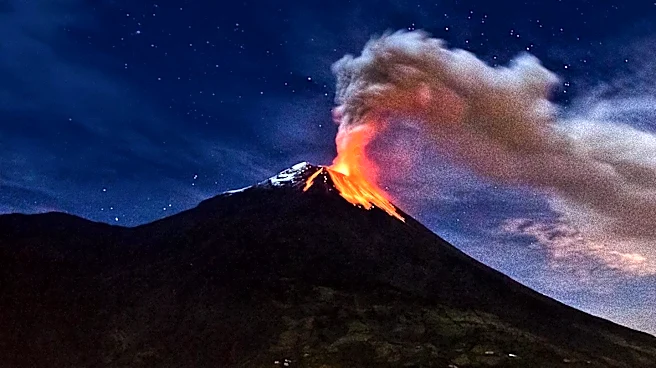
by A. Bougouin and colleagues, focused on Stromboli Island, Italy, a volcano known for its frequent eruptions and associated tsunamis. Researchers analyzed three specific tsunami-generating eruptions at Stromboli between 2019 and 2021, utilizing the island's unique monitoring system of land-based cameras and offshore wave gauges. In parallel, laboratory experiments were conducted using a 7-meter-long water channel where polystyrene beads were released down a slope to simulate pyroclastic flows entering the sea. This approach aimed to replicate the complex dynamics of how falling volcanic material interacts with seawater to generate waves, a process that has historically been poorly understood and difficult to predict in terms of tsunami occurrence and size.
Why It's Important?
This research is crucial for improving volcanic tsunami hazard assessments, which currently suffer from significant uncertainties. Previous models based solely on lab experiments often overestimated the size of tsunamis in real-world scenarios. By directly comparing experimental results with actual field data from Stromboli, the study identified limitations in existing models and provided a more accurate framework for prediction. The new experiments successfully reproduced key features observed at Stromboli, such as a three-wave pattern, and broadly captured the energy transfer from volcanic flows to wave trains. This enhanced understanding can lead to more reliable early warning systems and better preparedness for coastal communities vulnerable to volcanic tsunamis, potentially saving lives and mitigating damage in affected regions globally, including U.S. territories with volcanic activity.
What's Next?
The findings represent an initial step toward more accurate forecasting of volcanic-flow tsunamis. Future research will likely focus on refining laboratory models further, incorporating more variables, and applying these validated models to other active volcanoes worldwide. Scientists may also explore how different types of volcanic materials and oceanographic conditions influence tsunami generation. The improved understanding could lead to the development of more sophisticated predictive tools and hazard maps, enabling authorities to issue more precise evacuation orders and implement better disaster response strategies. Continued monitoring of active volcanoes like Stromboli, coupled with ongoing experimental validation, will be essential for building a comprehensive global volcanic tsunami warning system.
Beyond the Headlines
The study highlights the broader scientific challenge of scaling laboratory phenomena to real-world geophysical events. The discrepancy between lab predictions and field observations underscores the complexity of natural systems and the need for interdisciplinary approaches combining experimental physics, geological monitoring, and computational modeling. Ethically, more accurate tsunami predictions carry significant weight, as they directly impact public safety and resource allocation for disaster preparedness. Legally, improved hazard assessments could influence land-use planning in volcanic coastal areas and inform international cooperation agreements for disaster response. Culturally, a better understanding of these natural hazards can foster greater public awareness and resilience in communities living near active volcanoes, promoting a more informed relationship with natural risks.