









What's Happening?
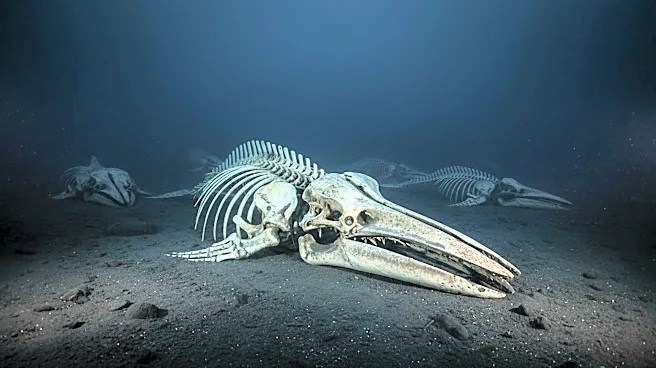
Chinese researchers have uncovered the world's largest whale graveyard at the bottom of the Indian Ocean, revealing a vast expanse of both new and ancient whale carcasses that support diverse deep-sea ecosystems. This discovery, published in the journal
Nature, includes nearly 500 skeletons found up to 7,000 meters deep along a 1,200-kilometer corridor. The site, known as the Diamantina Zone, is estimated to contain over 10 million carcasses, primarily from beaked whales. The research team, led by Xiaotong Peng of the Chinese Academy of Sciences, was astonished by the scale of the necropolis, which provides a significant source of sustenance for bottom-dwelling creatures. The discovery also identified a new, though extinct, species of whale. The whale carcasses, known as 'whale falls,' create ecosystems similar to those found around hydrothermal vents, supporting a variety of marine life including jellyfish, worms, and crustaceans.
Why It's Important?
The discovery of this massive whale graveyard has significant implications for understanding deep-sea ecosystems and the role of whale falls in supporting marine biodiversity. The site offers insights into whale evolution and distribution over geological time, as well as the ecological connections between different deep-sea communities. The presence of such a large number of carcasses also highlights the potential for these sites to sequester carbon, contributing to the ocean's role in carbon cycling. This finding could lead to further exploration of similar sites around the world, enhancing our knowledge of marine life and the ocean's ecological processes.
What's Next?
Future research may focus on exploring other potential whale graveyards identified off the coasts of South Africa, the Iberian Peninsula, and the Crozet Islands. Scientists are likely to conduct more submersible voyages to uncover additional sites and study the ecological dynamics of these unique environments. The discovery may also prompt further investigation into the causes of whale deaths in these areas and their impact on marine ecosystems. Continued research could provide valuable data for conservation efforts and the management of deep-sea resources.