








What's Happening?
Scientists have been closely monitoring exoplanet K2-18b, located 124 light years away in the constellation Leo, due to its potential to host life-supporting conditions. The planet, which orbits within the habitable zone of a red dwarf star, has an atmosphere
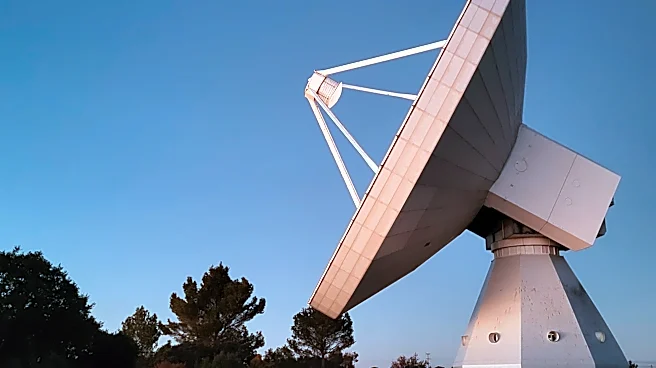
rich in carbon dioxide and methane, making it a prime candidate for the Search for Extraterrestrial Intelligence (SETI). Recently, researchers utilized the Karl G. Jansky Very Large Array in New Mexico and the MeerKAT radio telescope in South Africa to search for artificial radio transmissions from K2-18b. Despite identifying millions of potential signals, the study, published in The Astronomical Journal, found no evidence of narrowband radio signals indicative of extraterrestrial technology.
Why It's Important?
The search for extraterrestrial life is a significant scientific endeavor, as discovering life beyond Earth would have profound implications for our understanding of the universe. The findings from K2-18b, while not yielding evidence of alien technology, help establish upper bounds on the strength of potential radio transmitters in the system. This information is crucial for refining future search parameters and improving detection methods. The project also demonstrated the effectiveness of advanced data processing systems in handling large volumes of radio signals, a capability that will be essential as more powerful observatories come online.
What's Next?
Although no technosignatures were detected, the search for extraterrestrial intelligence continues. Future observatories, such as the Square Kilometer Array, will enhance the ability to detect faint signals from distant planets. The techniques developed in this study will be instrumental in processing the vast amounts of data these new facilities will generate. Researchers remain optimistic that continued advancements in technology and methodology will eventually lead to the detection of extraterrestrial life, if it exists.