



What's Happening?
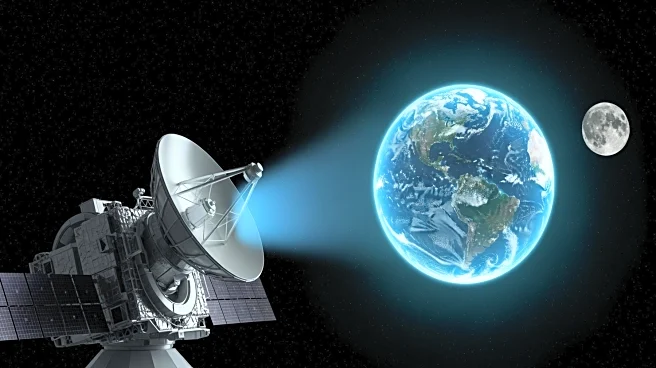
NASA's Carruthers Geocorona Observatory has successfully captured its first images from space, showcasing rare ultraviolet views of Earth and the Moon. These 'first light' images, taken on November 17, 2025, confirm the spacecraft's operational health
and offer a glimpse of the mission's potential. The images were captured using the observatory's Wide Field Imager and Narrow Field Imager, each providing different perspectives in far ultraviolet light and the specific wavelength known as Lyman-alpha. The images reveal Earth's geocorona, a faint ultraviolet glow emitted by hydrogen in Earth's outer atmosphere. This mission marks the first time the geocorona will be imaged repeatedly from a distance, allowing scientists to study its extent and changes over time. The observatory is positioned near the Sun-Earth Lagrange point 1, a location that provides a stable vantage point for observing Earth's outer atmosphere.
Why It's Important?
The Carruthers Geocorona Observatory's mission is significant for understanding Earth's outer atmosphere and its interaction with solar radiation. By capturing detailed images of the geocorona, scientists can gain insights into how Earth's atmosphere responds to solar activity, which is crucial for understanding space weather and its impact on satellite operations and communication systems. The ability to repeatedly image the geocorona from a stable vantage point allows for continuous monitoring, providing valuable data for atmospheric and space science research. This mission also highlights NASA's ongoing efforts to explore and understand Earth's environment from space, contributing to broader scientific knowledge and technological advancements.
What's Next?
The Carruthers Geocorona Observatory is set to begin its primary science phase in March 2026, during which it will conduct 30-minute exposures to capture more detailed images of the geocorona. This phase will provide a steady stream of data, enabling scientists to study the dynamics of Earth's outer atmosphere over time. The mission's findings could influence future space weather forecasting and satellite design, as understanding the geocorona's behavior is essential for mitigating potential disruptions to space-based technologies. As the observatory continues its mission, it will contribute to a deeper understanding of Earth's atmospheric processes and their implications for space exploration and technology.