







What's Happening?
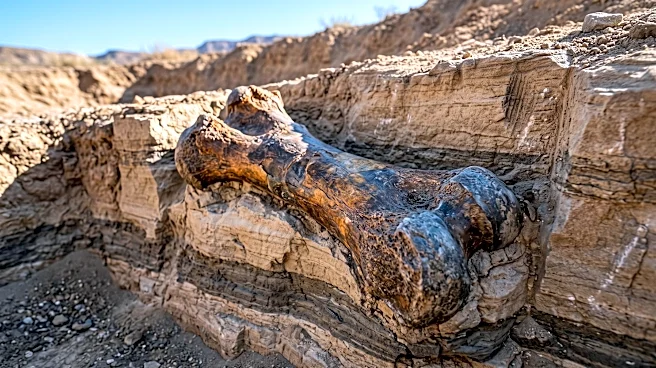
Construction crews working on a water department project in Oceanside, California, have uncovered fossilized remains that paleontologists believe could belong to a 'thunder beast' (brontothere) or a 'swamp rhinoceros' (amynodont). Contract paleontologist Joseph
El Adli discovered the fossils, including a femur estimated to be 2.5 to 3 feet long, within minutes of arriving at the site. These large, hoofed mammals lived approximately 45 million years ago during the Eocene Epoch, a period when the San Diego County region was a tropical jungle. The fossils were found in the Santiago formation, a sedimentary rock layer common in northwestern San Diego County. The remains are not actual bones but minerals that have replaced the original bone material over millions of years, turning them to rock. El Adli noted that the condition of the fossils suggests the animal died and was exposed to elements and predators before being covered and preserved by a flood. Most of the collected fossils appear to be limb and rib fragments, with some still encased in mudstone blocks for further study.
Why It's Important?
This discovery is significant for understanding the prehistoric biodiversity and environmental conditions of Southern California. The Eocene Epoch represents a crucial period in mammalian evolution, following the extinction of dinosaurs and preceding the Ice Age. Finding well-preserved fossils from this era, particularly of large mammals like brontotheres or amynodonts, provides valuable data for paleontologists studying ancient ecosystems, climate, and animal migration patterns in North America. The presence of such creatures indicates a vastly different climate and landscape in what is now a semi-arid region. Furthermore, the find highlights the importance of archaeological and paleontological monitoring during construction projects, as mandated by California's Environmental Quality Act. This ensures that significant historical and scientific resources are identified, preserved, and studied, contributing to a broader understanding of the region's natural history. The fossils will eventually be prepared for long-term storage and potential display at institutions like the San Diego Natural History Museum, making them accessible for public education and scientific research.
What's Next?
The immediate next steps involve the careful removal, study, and preservation of the unearthed fossils. Joseph El Adli and his team will meticulously examine the mudstone blocks containing the fossils at his workplace. This process will involve separating the fossils from the surrounding rock and looking for additional clues, such as signs of gnawing by carnivores, to understand the circumstances of the animal's death. A key objective is to locate a skull, which would definitively confirm the species of the animal. Once the initial preparation and study are complete, the fossils will be prepared for long-term storage. They are likely to be transferred to a museum, such as the San Diego Natural History Museum, for permanent preservation and further in-depth scientific analysis. City officials have not disclosed the exact location of the find to ensure the safety and integrity of the site, preventing unauthorized access or disturbance.
Beyond the Headlines
The discovery in Oceanside underscores the rich paleontological heritage embedded within urban development areas, particularly in regions like San Diego County, which are known for frequent fossil finds. This continuous unearthing of ancient life forms during construction projects highlights a broader ethical and regulatory challenge: balancing modern infrastructure needs with the preservation of irreplaceable scientific and cultural resources. The California Environmental Quality Act (CEQA) plays a critical role in this balance, mandating archaeological and cultural resource monitoring. However, such discoveries often lead to project delays and increased costs, prompting ongoing discussions about efficient and effective methods for resource management. Beyond the scientific implications, these finds also serve as powerful reminders of the deep geological time scales and the dynamic nature of Earth's environments, fostering a sense of connection to the planet's ancient past among the public. The 'thunder beast' discovery, in particular, evokes a sense of wonder about the colossal creatures that once roamed the region, enriching the local narrative beyond its human history.