





What's Happening?
Scientists at the Relativistic Heavy Ion Collider (RHIC), a U.S. Department of Energy (DOE) Office of Science User Facility, have successfully recreated quark-gluon plasma (QGP), an extraordinary form of matter from the early universe, by smashing oxygen
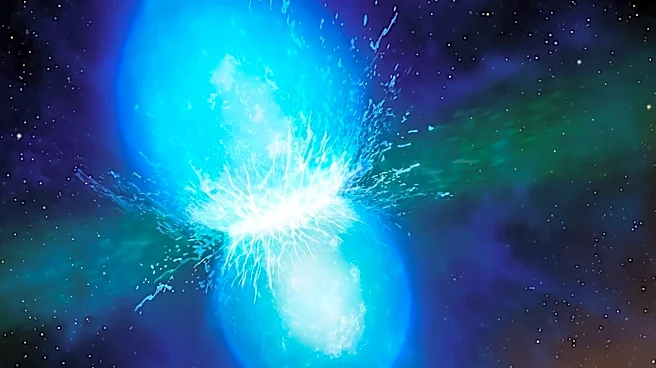
nuclei together at nearly the speed of light. This achievement, detailed in Physical Review Letters, provides strong evidence of QGP formation in surprisingly small atomic collisions. The key indicator was 'jet quenching,' where high-energy particle streams lose energy as they travel through the created material. This effect was previously observed in larger atomic nuclei collisions at RHIC and CERN's Large Hadron Collider (LHC). The new RHIC findings are significant because the oxygen collisions occurred at substantially lower energies, establishing a new lower boundary for the conditions known to produce QGP in small collision systems. This helps scientists narrow down the requirements for creating matter resembling that of the infant universe.
Why It's Important?
Understanding the properties of quark-gluon plasma is crucial for uncovering how the early universe evolved in its first microseconds, before the formation of protons and neutrons. This research, conducted at a U.S. DOE facility, pushes the boundaries of our knowledge about the fundamental building blocks of matter. By identifying the minimal conditions required to produce QGP, scientists can refine models of the Big Bang and the universe's initial moments. The ability to create QGP in smaller, lower-energy collisions offers a more accessible and controlled environment for studying this exotic state of matter. This advancement could lead to new insights into quantum chromodynamics, the theory governing the strong nuclear force, and potentially impact fields beyond astrophysics, such as materials science, by providing a deeper understanding of matter under extreme conditions.
What's Next?
Although RHIC has completed its operations, scientists still have additional oxygen collision data from the collider's final experimental run in 2021 and 2026, recorded by both the STAR and sPHENIX detectors. These remaining datasets will be analyzed to further investigate how small a collision system can be, and how low its energy can fall, before quark-gluon plasma can no longer form. This continued research aims to pinpoint the precise threshold at which the distinctive signatures of primordial matter disappear. Comparing these results with those from the LHC, which operated at much higher energies, will provide a comprehensive understanding of QGP formation across different energy scales and collision systems. The findings will help physicists piece together the behavior of matter during the first microseconds of the universe, when quarks and gluons existed freely before combining into ordinary atomic particles.
Beyond the Headlines
The recreation of quark-gluon plasma in smaller, lower-energy collisions has profound implications for our understanding of the universe's origins. It suggests that the conditions for this primordial matter might be less extreme than previously thought, potentially opening new avenues for its study. This research also highlights the power of international scientific collaboration, with contributions from various institutions and funding agencies. The continuous refinement of experimental techniques and theoretical models, driven by unexpected observations like those from the oxygen collisions, underscores the dynamic nature of scientific discovery. The quest to understand the universe's earliest moments is not just an academic pursuit; it informs our understanding of fundamental physics and the very nature of existence, potentially influencing future technological advancements through a deeper grasp of matter and energy.