


What's Happening?
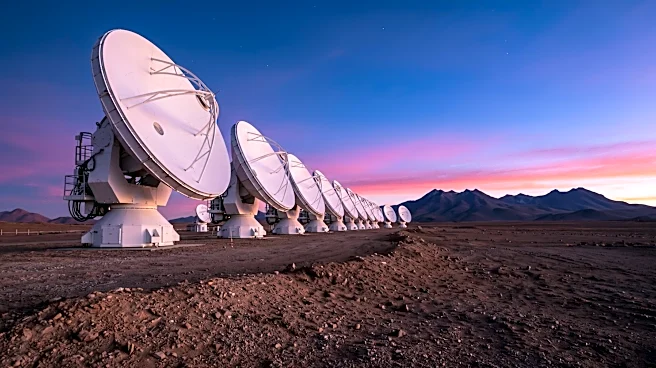
An international team of astronomers, utilizing the Atacama Large Millimeter/submillimeter Array (ALMA), has conducted a comprehensive survey of young stars, revealing a rich chemical environment, particularly the widespread presence of methanol. This
research, part of the ALMA COMPASS Large Program (Complex Organic Molecules in Protostars with ALMA Spectral Surveys), focused on 11 nearby young, Sun-like stars. The findings indicate that methanol maser emission is far more common around low-mass protostars than previously understood, with detections in over half of the observed stars. Furthermore, the survey achieved the first-ever detection in space of fully deuterated methanol (CD3OD), a rare variant where all hydrogen atoms are replaced by deuterium. This discovery was made around the young protostar IRAS 4A2, located approximately 1,000 light-years away in the Perseus molecular cloud. These initial results, presented in seven papers in Astronomy & Astrophysics, provide new insights into the complex chemistry occurring during the earliest stages of star formation.
Why It's Important?
The detection of widespread methanol and, notably, fully deuterated methanol around young stars is significant for understanding the origins of planetary systems and potentially life itself. Methanol, as the simplest alcohol, is a crucial precursor for more complex organic molecules. Its prevalence suggests that the building blocks for complex chemistry are readily available in the environments where stars and planets form. The discovery of fully deuterated methanol offers a unique chemical tracer, allowing astronomers to investigate the specific physical and chemical conditions under which these molecules form. This information is vital for developing more accurate models of star and planet formation, as it helps differentiate between chemical compositions inherited from interstellar clouds and those that evolve as stars mature. The U.S. National Science Foundation (NSF) is a key partner in ALMA, highlighting the U.S.'s role in advancing fundamental astronomical research and contributing to our understanding of the universe's chemical evolution.
What's Next?
The COMPASS team plans to continue analyzing the extensive dataset collected from the 11 young stars. Future research will extend beyond methanol to investigate other molecular species detected across all sources. A primary objective is to determine whether variations in chemical composition among young stars are inherent to their birth environments or develop later during stellar evolution. This ongoing analysis, combined with laboratory studies and chemical modeling, aims to trace the journey of material from cold interstellar clouds to the protoplanetary disks where planets eventually form. The insights gained will contribute to a more complete picture of how molecular complexity arises and influences the conditions for planet formation and the potential for life. The ALMA facility, supported by international partners including the U.S. National Science Foundation, will continue to be instrumental in these advanced astronomical observations.
Beyond the Headlines
The findings from the ALMA COMPASS survey delve into the fundamental question of astrobiology: how do the chemical precursors for life emerge in the cosmos? The presence of complex organic molecules like methanol in the early stages of star formation suggests that the chemical ingredients for life are not unique to Earth's solar system but are potentially widespread throughout the galaxy. This research has profound implications for the search for extraterrestrial life, as it indicates that the chemical conditions necessary for life to arise might be common. Understanding the chemical pathways in these stellar nurseries could inform future missions designed to detect biosignatures on exoplanets. The study also underscores the power of international scientific collaboration, with institutions from Europe, the U.S., and East Asia pooling resources and expertise to operate ALMA and push the boundaries of astronomical discovery.