
What's Happening?
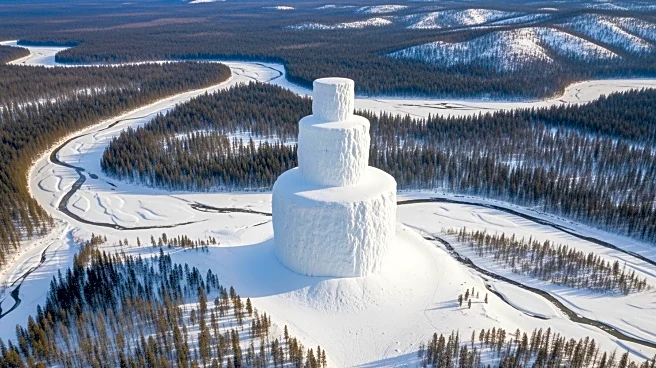
NASA's Landsat 8 satellite has captured a remarkable image of a natural snowman formation on Russia's Chukchi Peninsula. The image, taken on June 16, 2025, shows a series of elongated, oval lagoons near
Billings and Cape Billings that align to resemble a stacked snowman when viewed from above. Despite being mid-June, the area remains locked in ice, with average daily minimum temperatures around -30.9°F. The snowman formation is a result of the unique geomorphic 'edge zone' where land, water, ice, and wind interact. Landsat 8, launched in 2013, is operated by NASA and the U.S. Geological Survey and is known for its ability to track Earth's surface changes over time.
Why It's Important?
The image highlights the importance of satellite technology in monitoring environmental changes, particularly in sensitive Arctic regions. The snowman formation provides insight into permafrost landscapes and coastal Arctic dynamics, which are crucial for understanding seasonal ice persistence. This information is vital for predicting the impacts of climate change on ecosystems, coastal erosion, and human activities. Landsat 8's consistent and repeatable imagery allows scientists to detect environmental changes over time, making it an indispensable tool for researchers studying the effects of global warming.
What's Next?
The continued use of Landsat 8 and other satellites will provide ongoing data to monitor changes in the Arctic and other regions affected by climate change. Researchers will likely use this data to study the long-term impacts of warming temperatures on ice cover and coastal dynamics. The insights gained from these observations could inform policy decisions and strategies to mitigate the effects of climate change on vulnerable ecosystems and communities.
Beyond the Headlines
The snowman formation, while visually striking, underscores the broader implications of climate change in the Arctic. As temperatures rise, the timing and extent of ice cover will shift, affecting local wildlife and human activities. The image serves as a reminder of the interconnectedness of natural systems and the need for comprehensive monitoring to understand and address the challenges posed by a changing climate.