





What's Happening?
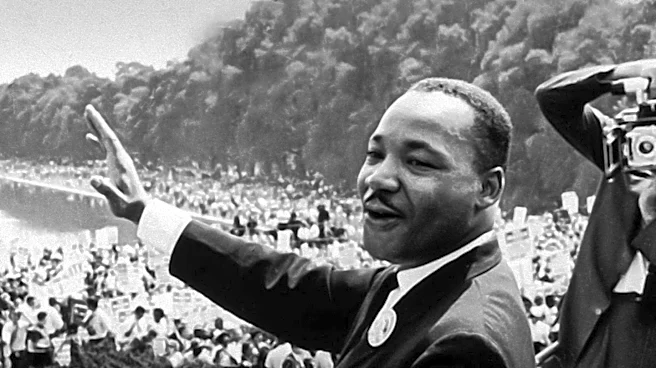
A new book by Marcia Chatelain, titled 'How Bright the Path Grows,' aims to shed light on the often-overlooked contributions of women to the 1963 March on Washington for Jobs and Freedom. The book challenges the conventional narrative that primarily focuses
on Dr. Martin Luther King Jr.'s 'I Have a Dream' speech, arguing that this singular focus has obscured the vital roles played by Black women. These women were actively involved in fundraising, strategizing, organizing, and resisting for various causes within the civil rights movement, including school desegregation, voting rights, and ending police brutality. The book highlights how these women were frequently portrayed in the press as mere 'helpmates' or 'spouses' to male leaders, effectively erasing their significant efforts from historical records. Chatelain's work, inspired by reporter Lula Patterson's observations during the march, seeks to correct this historical oversight.
Why It's Important?
This re-examination of the March on Washington is crucial for a more comprehensive and accurate understanding of the civil rights movement. By centering the experiences and contributions of Black women, the book challenges a male-centric historical narrative that has long minimized their agency and impact. Recognizing these women's roles is vital for acknowledging the full scope of the movement's success and the diverse individuals who propelled it forward. It also highlights the systemic sexism prevalent even within movements striving for equality, where women's efforts were often undervalued or rendered invisible. For contemporary social justice movements, this historical corrective serves as a reminder to actively seek out and amplify marginalized voices, ensuring that all contributors are recognized and that future historical accounts are more inclusive and representative.
What's Next?
The publication of 'How Bright the Path Grows' is expected to spark renewed interest and discussion about the roles of women in the civil rights movement. It will likely encourage further academic research and public discourse aimed at uncovering and celebrating the stories of other unsung heroes. Educational institutions and historical organizations may incorporate these new perspectives into their curricula and exhibitions, providing a more nuanced understanding of this pivotal period in U.S. history. The book's impact could extend beyond historical scholarship, influencing contemporary social justice movements to be more intentional about gender inclusivity and leadership representation. It also serves as a call to action for journalists and historians to critically examine existing narratives and actively seek out diverse perspectives when documenting significant events.
Beyond the Headlines
The book delves into the deeper implications of historical erasure and the politics of memory. By focusing on how women's contributions were marginalized, it exposes the inherent biases in historical record-keeping and the power dynamics that determine whose stories are told and remembered. The narrative of the March on Washington, often simplified to King's speech, loses much of its complexity and the collective effort that made it possible. Chatelain's work implicitly argues that a more inclusive historical understanding is not just about correcting facts but about recognizing the full spectrum of human agency and struggle. This broader perspective can inform how we approach current social issues, encouraging a more critical engagement with dominant narratives and a greater appreciation for the diverse forms of activism that drive social change. It also underscores the ongoing need for feminist historians and scholars to challenge established canons and bring marginalized histories to the forefront.