



What's Happening?
Astronomers at the University of Arizona have published new research in Nature Astronomy, indicating that early galaxies began dispersing heavy elements like carbon and oxygen into intergalactic space much earlier than previously thought. This discovery
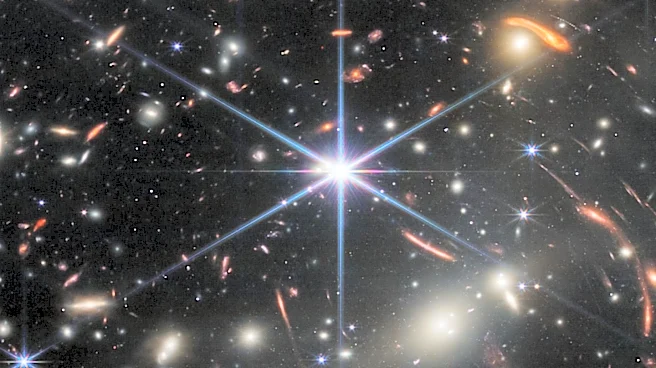
challenges the long-held assumption that gas surrounding newly formed galaxies in the early universe remained largely pristine, composed primarily of hydrogen and helium. The study, led by Yongda Zhu, a Postdoctoral Researcher in the Department of Astronomy and Steward Observatory, focused on three early galaxies observed approximately 500 million years after the Big Bang, during the Epoch of Reionization. Using NASA’s James Webb Space Telescope (JWST), researchers analyzed the absorption patterns of light from these distant galaxies as it passed through surrounding gas. The JWST's infrared capabilities allowed for detailed observation of these galaxies as they appeared about 13 billion years ago. The analysis revealed faint absorption signatures consistent with heavy elements, including carbon, oxygen, and silicon, which were found to be moving away from the galaxies, indicating their dispersal into intergalactic space.
Why It's Important?
This research significantly alters our understanding of cosmic evolution and the formation of stars and planets. Previously, it was believed that heavy elements were dispersed much later in the universe's history. The finding that galaxies were enriching their surroundings with elements like carbon and oxygen within the first 500 million years after the Big Bang suggests a more rapid and widespread distribution of these crucial building blocks. This early dispersal, termed baryon cycling, means that the material formed by one generation of stars was quickly reused and redistributed across the galactic ecosystem. This has profound implications for the search for Population III stars, the first generation of stars theorized to have formed from pristine hydrogen and helium. If heavy elements were already prevalent so early, genuinely pristine gas might have been scarce, making the detection of these first stars even more challenging. The chemical signatures observed in these young galaxies are remarkably similar to those seen in galaxies billions of years later, reinforcing the idea that the fundamental processes of element production and distribution were established very early in the universe's history.
What's Next?
The findings from this study will likely prompt further investigations into the early universe and the mechanisms of baryon cycling. Researchers will continue to utilize advanced telescopes like the JWST to observe more distant galaxies and gather additional data on their elemental compositions and dispersal patterns. The challenge of detecting Population III stars will become a more focused area of research, with astronomers potentially refining their search strategies based on the understanding that pristine gas might have been less common than previously assumed. Future studies may also explore the precise rates and distances over which these heavy elements were dispersed, and how this early enrichment influenced the formation of subsequent generations of stars, planets, and ultimately, life. The University of Arizona and other astronomical institutions will likely pursue follow-up observations and theoretical modeling to build upon these initial discoveries and create a more complete picture of the universe's chemical evolution.
Beyond the Headlines
The early and widespread dispersal of heavy elements has profound implications for the cosmic origins of life. Carbon and oxygen are fundamental to organic chemistry and the formation of habitable planets. If these elements were distributed throughout the universe much earlier, it suggests that the conditions necessary for life to emerge could have been present sooner and in more locations than previously theorized. This research also highlights the interconnectedness of cosmic phenomena, demonstrating that galaxies are not isolated entities but rather active participants in a dynamic exchange of matter that shapes the entire universe. The metaphor of 'food dye dropped into a cup of water' effectively illustrates how these elements spread, enriching their surroundings and providing the raw materials for future cosmic structures. This early enrichment could mean that the universe was 'primed' for complexity and diversity much earlier in its existence, potentially influencing the timeline and prevalence of exoplanet formation and the development of complex chemistry across the cosmos.