








What's Happening?
Following World War II, the United States initiated a secret program known as Operation Paperclip, which brought German scientists, including former Nazi Party members and SS officers, to the U.S. to work on advanced weapons and space technology. Wernher
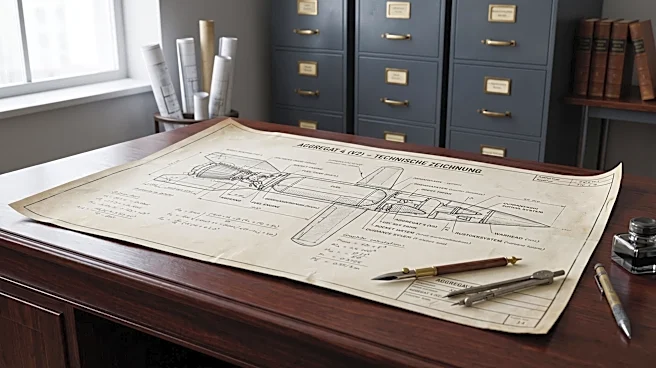
von Braun, scientific director of the V-weapons project and head of the Mittelbau-Dora planning office, along with Major General Walter Dornberger, head of the German army’s weapons department, leveraged hidden V2 rocket design documents to secure amnesty with the Americans. These scientists, who had utilized slave labor from concentration camps like Mittelbau-Dora for V2 rocket production, were integrated into U.S. programs. The V2 rocket, the world's first long-range guided ballistic missile, was responsible for thousands of civilian deaths in London and Antwerp, and its production led to the deaths of at least 20,000 prisoners in Mittelbau-Dora and Mittelwerk. The U.S. sought their expertise for its burgeoning space and missile programs, effectively whitewashing their past involvement with the Nazi regime.
Why It's Important?
The integration of Nazi scientists into the U.S. space program under Operation Paperclip significantly accelerated American advancements in rocketry and space exploration, directly contributing to the space race against the Soviet Union. This decision prioritized technological superiority and national security over prosecuting war criminals, raising profound ethical questions about the compromises made during the Cold War. Figures like von Braun became public leaders in the U.S. space program, designing rockets for America's first satellite and managing key NASA centers. This historical context reveals the complex and often morally ambiguous origins of some of America's greatest technological achievements, highlighting how geopolitical competition can influence ethical considerations in scientific pursuits. The legacy of Operation Paperclip continues to spark debate about accountability, justice, and the true cost of scientific progress.
What's Next?
While Operation Paperclip concluded decades ago, its historical implications continue to be examined. Ongoing discussions often revolve around the ethical responsibilities of governments and scientific communities in times of conflict and technological competition. The acknowledgment of the scientists' pasts has led to a re-evaluation of historical narratives surrounding the U.S. space program. Future historical analyses and educational initiatives may further explore the human cost and moral compromises associated with these advancements. The National Space Society continues to award the 'Wernher von Braun Memorial Award,' indicating a complex and sometimes controversial legacy that persists in contemporary recognition of space-related achievements.
Beyond the Headlines
The story of Operation Paperclip extends beyond the immediate technological gains, touching upon deeper themes of historical revisionism, moral relativism, and the long-term impact of wartime decisions. The program effectively granted immunity to individuals complicit in war crimes, allowing them to contribute to a new superpower's scientific endeavors. This raises questions about the nature of justice and whether scientific utility can ever outweigh moral culpability. The narrative also underscores the pervasive influence of the Cold War, where the imperative to gain an advantage over the Soviet Union often overshadowed ethical considerations. The continued veneration of figures like von Braun, despite their past, reflects a societal struggle to reconcile scientific achievement with historical atrocities, prompting ongoing reflection on how history is remembered and celebrated.