







What's Happening?
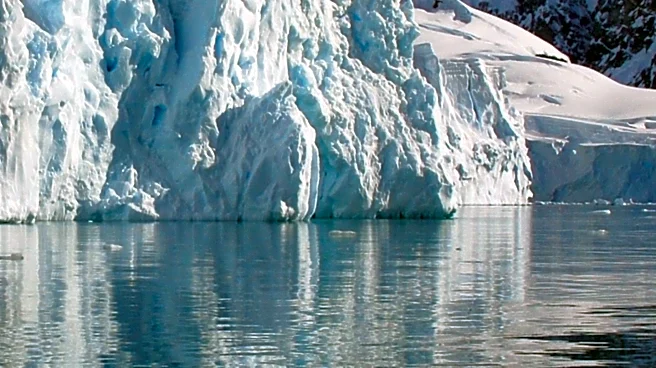
A recent study has quantified the impact of human-driven climate change on the retreat of the Pine Island Glacier in Antarctica. Researchers from King’s College London and the British Antarctic Survey have found that greenhouse gas emissions have increased
the glacier's retreat by approximately 18-20% since the 1940s. This retreat has pushed the glacier several miles further inland than it would have moved naturally. The study, published in The Cryosphere, uses satellite imagery and advanced modeling to isolate the effects of human-driven global warming from natural variability. The findings highlight that while the glacier's retreat began in the 1940s, human-driven ocean warming since the 1960s has significantly intensified this process.
Why It's Important?
The retreat of the Pine Island Glacier is a significant contributor to global sea level rise, and its accelerated retreat due to human activity underscores the urgent need for climate action. The glacier is one of the fastest-changing in Antarctica, and its destabilization could lead to substantial increases in sea levels. This study provides one of the clearest attributions of Antarctic ice loss to human activity, emphasizing the role of greenhouse gas emissions in shaping the trajectory of ice loss. The findings serve as a stark reminder of the long-term impacts of current emissions on global climate systems and the potential for significant environmental and societal consequences.
What's Next?
The study suggests that while the Pine Island Glacier may temporarily slow its retreat later this century as it reaches a ridge beneath the ice, this stabilization is likely to be short-lived if warming continues. Human-driven climate change is expected to remain a dominant driver of retreat in the longer term. The research highlights the need for immediate and sustained efforts to reduce greenhouse gas emissions to mitigate future impacts on Antarctic ice loss and global sea levels. Continued monitoring and research are essential to understand and predict the glacier's behavior and its implications for global climate change.
Beyond the Headlines
This study provides a critical link between human activity and changes in Antarctica, an area where such attributions have been challenging due to complex ocean and ice interactions. The research not only highlights the direct impact of human-driven climate change on ice loss but also underscores the importance of using advanced modeling techniques to understand these processes. The findings contribute to a growing body of evidence that human influence is a significant factor in global climate change, with long-term implications for environmental policy and international climate agreements.