



What's Happening?
A recent study published in Eos has revealed that aging stars may consume their closest planets, offering insights into the potential fate of Earth. Using data from NASA's Transiting Exoplanet Survey Satellite (TESS), researchers Edward Bryant from the University
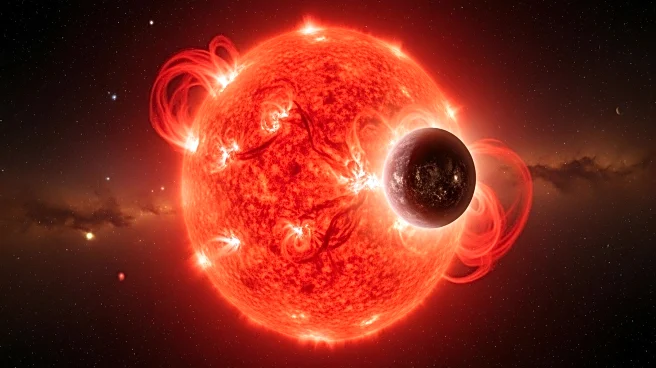
of Warwick and Vincent Van Eylen from University College London analyzed hundreds of thousands of aging stars. They discovered that as stars deplete their hydrogen fuel and expand into red giants, they often engulf nearby planets. This phenomenon, known as tidal decay, causes planets to spiral inward and eventually be consumed by their host stars. The study identified 130 planets and candidates orbiting close to post-main-sequence stars, highlighting a significant decrease in the number of planets around older stars compared to younger ones.
Why It's Important?
The findings of this study have significant implications for our understanding of stellar evolution and planetary survival. As our sun is approximately halfway through its life cycle, this research provides a glimpse into the distant future of our solar system. The potential for Earth to be consumed by the sun as it becomes a red giant raises questions about the long-term habitability of planets in similar systems. This research also advances the field of exoplanet science by providing new methods to study the interaction between aging stars and their planets. The study's approach could lead to a better understanding of how often and how quickly planets are destroyed, contributing to the broader knowledge of stellar-planetary coevolution.
What's Next?
The study paves the way for future research using upcoming missions like the European Space Agency's Plato Mission, scheduled for launch in December 2026. These missions will continue to explore the occurrence rates of planets around aging stars, providing more data to refine our understanding of tidal decay and planetary destruction. As astronomers gather more information, they will be able to quantify the processes involved in stellar-planetary interactions more accurately. This research could also inform the search for habitable exoplanets by identifying systems where planets are more likely to survive the life cycle of their host stars.
Beyond the Headlines
The study highlights the complex dynamics between stars and their planets, emphasizing the importance of understanding these interactions for the future of planetary science. The potential for planets to be consumed by their stars raises ethical and philosophical questions about the long-term sustainability of life in the universe. As scientists continue to explore these phenomena, they may uncover new insights into the resilience of planetary systems and the conditions necessary for life to thrive. This research also underscores the need for continued investment in space exploration and the development of advanced observational technologies.