






What's Happening?
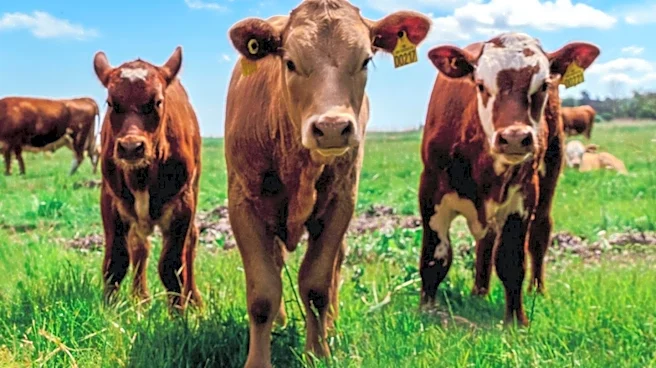
A new analysis, commissioned by Greenpeace International, suggests that the U.S. livestock industry, along with other major livestock-exporting countries, may be using a method called 'global warming potential*' (GWP*) to significantly underreport its
methane emissions and conceal its true climate impact. Researchers argue that this method allows countries to claim substantial reductions in emissions even with minor actual cuts, and in some cases, report 'negative emissions.' The report indicates that the U.S. livestock industry could claim 218 metric tons of negative carbon dioxide emissions by 2030, while actually emitting 178 million metric tons. This discrepancy is equivalent to the annual emissions of approximately 86 million cars. Critics, including Jennifer Molidor of the Center for Biological Diversity, describe this as 'creative accounting and fuzzy math,' which benefits high livestock producers by allowing them to maintain stable emission levels based on a recent baseline.
Why It's Important?
This analysis raises critical questions about the accuracy and transparency of climate reporting within the U.S. livestock industry and its implications for global climate goals. If the claims of 'bookkeeping tricks' are accurate, it means that efforts to reduce methane emissions, a potent greenhouse gas, could be significantly undermined. The U.S. livestock industry is a major contributor to methane emissions, and misrepresenting these figures could hinder the nation's ability to meet its climate commitments, such as those under the Global Methane Pledge. This could also impact public perception and policy decisions regarding sustainable agriculture and dietary choices. The debate over GWP* highlights the complexity of measuring and attributing climate impacts, and who stands to gain or lose from different accounting methodologies. Environmental advocates and climate scientists are pushing for more accurate and transparent reporting to ensure genuine progress in combating climate change.
What's Next?
The findings of this report are likely to fuel further debate and scrutiny at upcoming international climate summits, such as the United Nations annual climate summit in Turkey. Climate negotiators and policymakers will face increased pressure to critically evaluate the methodologies used for measuring methane emissions, particularly GWP*. There may be calls for more standardized and robust reporting mechanisms that accurately reflect the warming power of methane. The U.S. livestock industry may face increased pressure from environmental groups and potentially from regulatory bodies to adopt more transparent and scientifically sound methods for reporting emissions. This could lead to a re-evaluation of current climate strategies and a push for more aggressive and verifiable methane reduction targets within the agricultural sector.
Beyond the Headlines
The controversy surrounding GWP* extends beyond mere accounting; it touches upon the fundamental scientific understanding of climate change and the political will to address it. While climate scientists acknowledge the legitimacy of GWP* as a tool to understand methane's behavior, they express concern that it is being misused to weaken emission reduction efforts. This situation mirrors past instances where industries have employed complex accounting methods to downplay environmental impacts. The report's implications could lead to a deeper examination of how scientific metrics are adopted and applied in policy, especially when economic interests are at stake. It also underscores the ongoing challenge of translating complex climate science into actionable and equitable policy, and the need for independent oversight to prevent the manipulation of data for industry benefit.