






What's Happening?
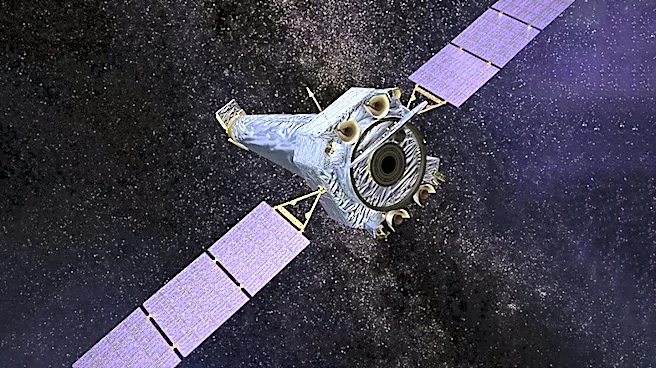
NASA has announced that the PRobe far-Infrared Mission for Astrophysics (PRIMA) space telescope is moving into its next phase of development, Phase B. This mission represents the first in a new class of NASA astrophysics missions, termed 'Probe Explorers,'
under the agency's long-standing 'Explorers Program.' PRIMA is designed to explore the universe's history and evolution by conducting deep, sensitive surveys in far-infrared light. The mission aims to bridge the observational gap between existing infrared observatories, such as the James Webb Space Telescope, and radio telescopes. The project's cost is capped at $1.2 billion, excluding launch and other non-project expenses, and it is targeted for a 2033 launch with a planned five-year mission duration. NASA's Jet Propulsion Laboratory in Southern California will manage the PRIMA mission, with additional contributions from NASA's Goddard Space Flight Center and Marshall Space Flight Center, as well as international partners including CNES (France), ASI (Italy), DLR (Germany), CSA (Canada), KASI (South Korea), JAXA (Japan), and the UK Space Agency.
Why It's Important?
The PRIMA mission is crucial for advancing humanity's understanding of the deep universe. By studying radiant energy in the far-infrared spectrum, PRIMA will address fundamental questions about the origins of planets outside our solar system, the growth and evolution of galaxies and their black holes over cosmic history, and the accumulation of dust and heavy elements in the universe. This research will provide a more comprehensive picture of how the universe came to be and why it looks the way it does today. The mission's focus on far-infrared light is particularly significant as it allows for the observation of phenomena that are obscured in other wavelengths, offering unique insights into cosmic processes. The development of PRIMA also signifies NASA's commitment to maintaining a consistent pipeline of premier-class astrophysics missions, following the success of telescopes like Webb and Roman, ensuring continuous advancements in space exploration and scientific discovery.
What's Next?
PRIMA is currently in Phase B, which involves advancing its preliminary design and technology development. The mission will undergo a confirmation review to assess its technical, programmatic, and cost performance before proceeding to Phase C, the implementation stage. If confirmed, the observatory is slated for launch in 2033, embarking on a five-year mission. The Max Planck Institute for Astronomy (MPIA) plans to contribute opto-mechanical components and control electronics to the mission. The successful progression of PRIMA will depend on its ability to meet the stringent technical and financial requirements set by NASA and its international partners. Future steps will involve detailed design, construction, and rigorous testing of the telescope and its instruments, leading up to its anticipated launch and subsequent scientific operations.
Beyond the Headlines
The PRIMA mission embodies a broader shift in astronomical research towards multi-wavelength observation, recognizing that different parts of the electromagnetic spectrum reveal distinct aspects of cosmic phenomena. Its ability to probe the far-infrared will unveil processes hidden from current telescopes, potentially leading to paradigm-shifting discoveries about the early universe and the conditions necessary for life. Furthermore, the extensive international collaboration involved in PRIMA highlights the global nature of modern space exploration, fostering scientific diplomacy and shared technological advancements. This collaborative model not only pools resources and expertise but also ensures a wider dissemination of scientific knowledge and benefits. The mission's long-term impact could extend beyond astrophysics, inspiring future generations in STEM fields and reinforcing the human drive for exploration and understanding of our place in the cosmos.