

What's Happening?
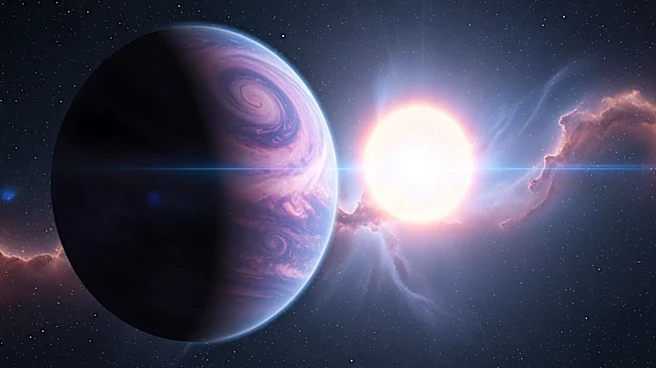
Astronomers have discovered a massive exoplanet, TOI-5205 b, orbiting a small red dwarf star, challenging existing theories of planetary formation. This Jupiter-sized planet orbits a star much smaller and less massive than the Sun, contradicting models
that suggest such stars cannot form or retain large planets. The planet's atmosphere, studied using the James Webb Space Telescope, revealed unexpected chemical compositions, including the presence of methane and hydrogen sulfide but a deficiency in heavier elements. This anomaly suggests unusual processes during the planet's formation, prompting a reevaluation of how such systems evolve.
Why It's Important?
The discovery of TOI-5205 b has significant implications for our understanding of planetary formation, particularly around M-dwarf stars, which are the most common in the galaxy. The planet's unique atmospheric composition challenges existing models and suggests that similar 'forbidden' planets may exist, potentially altering our understanding of planetary systems. This finding could lead to new insights into the diversity of exoplanets and the processes that govern their formation and evolution, impacting future astronomical research and exploration.
What's Next?
Further observations and studies are needed to understand the processes that led to the formation of TOI-5205 b. The research team plans to continue using the James Webb Space Telescope to study similar systems, which may reveal more 'forbidden' planets and refine existing models. This ongoing research will contribute to a broader understanding of planetary formation and the diversity of exoplanetary systems, potentially leading to new discoveries and theories in the field of astronomy.