
What's Happening?
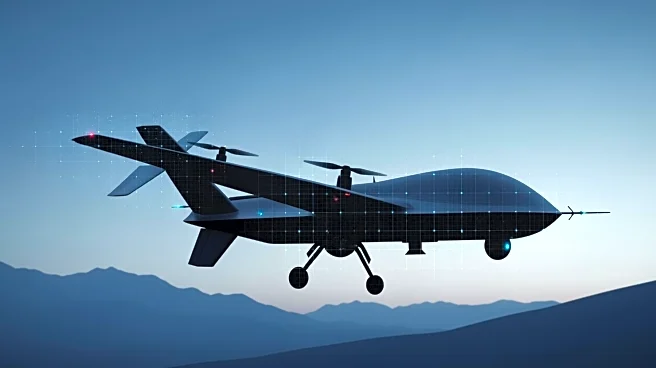
Lockheed Martin has confirmed that its RQ-170 Sentinel unmanned aerial vehicle played a significant role in a recent U.S. military operation in Venezuela, known as 'Operation Absolute Resolve.' This operation culminated
in the capture of Venezuelan leader Nicolás Maduro on January 3, 2026. The RQ-170 Sentinel, developed by Lockheed Martin's Skunk Works, is a stealthy intelligence, surveillance, and reconnaissance (ISR) platform. The confirmation marks a rare public acknowledgment of the aircraft's deployment, which has been shrouded in secrecy since its introduction. The Sentinel's involvement in the operation was highlighted by Lockheed CEO Jim Taiclet during a quarterly earnings call, where he also mentioned the use of F-35 and F-22 fighters and Sikorsky Black Hawk helicopters. The drone's primary contribution was providing real-time situational awareness by orbiting at high altitudes, allowing commanders to track critical sites and troop movements.
Why It's Important?
The confirmation of the RQ-170 Sentinel's role in the Venezuelan operation underscores the evolving nature of modern military engagements, where advanced ISR capabilities are crucial. The Sentinel's stealth and passive collection abilities make it a valuable asset in operations against adversaries with sophisticated air defenses. Its deployment in Venezuela highlights the U.S. military's reliance on cutting-edge technology to achieve strategic objectives while minimizing risks to personnel. The operation also reflects a shift in the Sentinel's role from a strategic ISR asset to a tactical enabler in joint operations, demonstrating the importance of integrating advanced reconnaissance tools in modern warfare. This development has implications for U.S. military strategy and the defense industry's focus on stealth and intelligence capabilities.
What's Next?
The successful deployment of the RQ-170 Sentinel in Venezuela may lead to increased utilization of such advanced ISR platforms in future military operations. The U.S. military is likely to continue refining its strategies to leverage the Sentinel's capabilities in complex environments. Additionally, Lockheed Martin and other defense contractors may see increased demand for similar technologies, prompting further research and development in stealth and reconnaissance systems. The operation's success could also influence U.S. foreign policy and military engagements, particularly in regions with high geopolitical tensions.
Beyond the Headlines
The use of the RQ-170 Sentinel in Venezuela raises questions about the ethical and legal implications of deploying advanced surveillance technologies in international operations. The drone's ability to conduct reconnaissance without detection poses challenges for international norms and agreements on military engagements. Furthermore, the operation highlights the ongoing arms race in stealth and ISR technologies, with potential consequences for global security dynamics. As countries develop similar capabilities, the risk of escalation and conflict may increase, necessitating new frameworks for international cooperation and regulation.