
What's Happening?
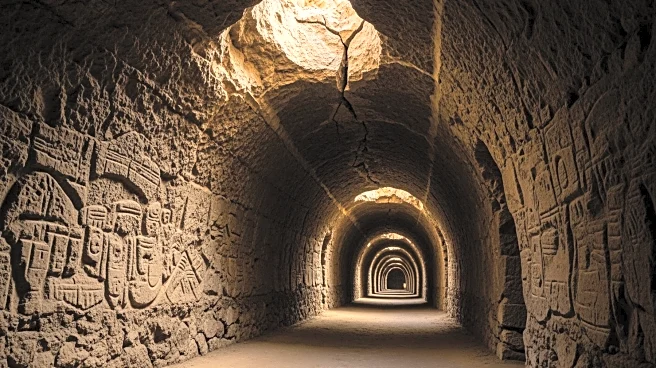
Recent discoveries of massive underground tunnels across South America have sparked significant scientific interest. These tunnels, found primarily in Brazil, Argentina, and Uruguay, are characterized
by their size and smooth, uniform walls, which suggest they were not created by humans. Instead, fossilized footprints and claw marks indicate that these structures were likely excavated by prehistoric giant ground sloths during the late Pleistocene era. The tunnels, known as palaeoburrows, are several meters wide and high enough for a person to walk through, extending for miles in some cases. Geological analysis suggests they were dug into moderately soft rock and compacted sediments, materials that would have been challenging for humans to excavate without tools. The discovery of these tunnels provides new insights into the behavior and environmental impact of extinct megafauna, challenging previous assumptions about prehistoric ecosystems.
Why It's Important?
The discovery of these tunnels is significant as it challenges the traditional view that humans were the primary agents of large-scale environmental modification in prehistoric times. The existence of these palaeoburrows suggests that giant ground sloths played a substantial role in shaping their environment, affecting soil quality and water movement. This finding adds complexity to our understanding of ancient ecosystems and the interactions between humans and megafauna. It also highlights the importance of trace fossils, such as footprints and claw marks, in reconstructing the behaviors and ecological roles of extinct species. The research underscores the need to reconsider the ecological impact of large animals and their extinction, which has implications for contemporary conservation efforts.
What's Next?
Further research is likely to focus on documenting more sites and analyzing the tunnels to gain a clearer picture of the interactions between megafauna and their environment. Scientists may also explore the implications of these findings for understanding the ecological roles of large animals and their impact on ecosystems. This research could inform conservation strategies by highlighting the importance of preserving large animal species and their habitats. Additionally, the study of these tunnels may lead to a reevaluation of the role of extinct species in shaping prehistoric landscapes, potentially influencing how we interpret archaeological and paleontological evidence.
Beyond the Headlines
The discovery of these tunnels raises questions about the underestimated influence of extinct megafauna on their environments. It challenges the anthropocentric view of history, suggesting that non-human species were also capable of significant environmental engineering. This finding may prompt a reevaluation of the ecological roles of large animals and their contributions to biodiversity and ecosystem stability. The research also highlights the potential for trace fossils to provide valuable insights into the behaviors and interactions of extinct species, offering a more nuanced understanding of prehistoric ecosystems.