
What's Happening?
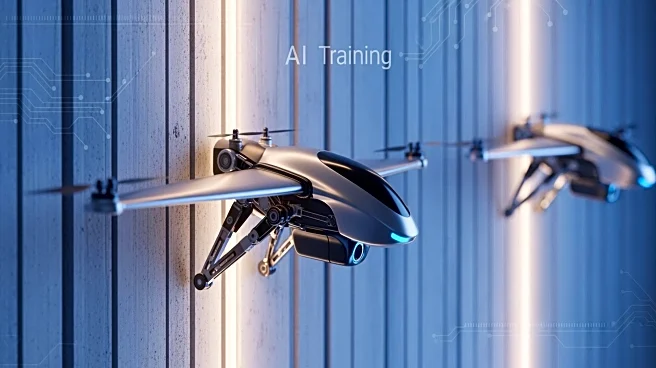
A recent study has developed a machine learning-based framework to improve the wall-perching abilities of flying robots. The research focuses on a spiny flying and wall-climbing robot designed with a multimodal
approach, incorporating flight, landing, and attachment systems. The robot's perching process involves four stages: approaching the wall, contact-impact, rotation, and attachment using spines similar to beetle tarsal claws. The study utilizes a knowledge-driven model to simulate the robot's landing dynamics, which is then enhanced by a data-driven model using machine learning. This approach allows for the prediction of successful or failed landings based on various initial conditions such as pitch, velocity, and lift. The integration of machine learning aims to optimize the robot's landing strategy, reducing the time and cost associated with traditional simulation methods.
Why It's Important?
The development of advanced AI training methods for flying robots has significant implications for various industries, particularly in areas requiring precise and autonomous operations. By improving the accuracy and efficiency of wall-perching, these robots can be deployed in complex environments for tasks such as surveillance, inspection, and maintenance. The ability to predict landing success through machine learning reduces the need for extensive physical testing, thereby accelerating the development process and lowering costs. This advancement also highlights the growing role of AI in enhancing robotic capabilities, potentially leading to more widespread adoption of autonomous systems in both commercial and industrial applications.
What's Next?
Future developments may focus on refining the data-driven model to further enhance prediction accuracy and expand the robot's operational capabilities. Researchers might explore additional applications for the technology, such as integrating it into other types of robots or adapting it for different environmental conditions. The continued evolution of AI training methods could lead to more sophisticated autonomous systems capable of performing a wider range of tasks with minimal human intervention. Stakeholders in robotics and AI industries will likely monitor these advancements closely, considering potential collaborations or investments to leverage the technology's benefits.
Beyond the Headlines
The integration of AI in robotic systems raises ethical and regulatory considerations, particularly concerning the deployment of autonomous machines in public spaces. Ensuring the safety and reliability of these systems is paramount, necessitating robust testing and validation processes. Additionally, the use of AI in robotics may prompt discussions about the impact on employment, as automation could replace certain manual tasks. Balancing technological progress with societal implications will be crucial as AI-driven robots become more prevalent.