


What's Happening?
Researchers from the University of Calgary and the National Research Council of Canada have conducted a study revealing that living organisms, including humans, emit a faint visible light, which ceases upon death. This phenomenon, known as ultraweak photon
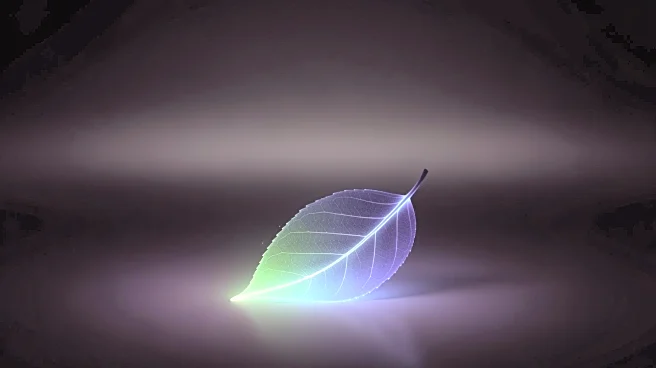
emission (UPE), was observed in experiments involving mice and plant leaves. The study found that the light emission is significantly reduced after death, suggesting a link between the glow and the health of living cells. The research involved imaging live and deceased mice, as well as stressed plant leaves, to capture the faint light emissions. The findings indicate that reactive oxygen species, produced by stressed cells, may be responsible for this biophoton emission.
Why It's Important?
The discovery of ultraweak photon emission in living organisms could have significant implications for medical diagnostics and research. By providing a non-invasive method to monitor cellular stress, this phenomenon could help in assessing the health of tissues in humans and animals. The ability to detect such emissions might lead to new diagnostic tools that can identify stress or disease in cells without the need for invasive procedures. Additionally, understanding the mechanisms behind this light emission could advance research in fields such as biochemistry and cellular biology, potentially leading to new treatments or therapies for various conditions.
What's Next?
Future research may focus on further exploring the mechanisms behind ultraweak photon emission and its potential applications in medical diagnostics. Scientists might investigate how this phenomenon can be harnessed to develop new non-invasive diagnostic tools for detecting cellular stress or disease. Additionally, studies could aim to understand the variations in light emissions across different species and conditions, which could provide insights into the health and stress levels of organisms. The development of more sensitive imaging technologies could also enhance the ability to detect and analyze these faint emissions.
Beyond the Headlines
The study of biophoton emissions challenges traditional views of biological processes and opens up new avenues for understanding the interactions between light and living organisms. This research could lead to a deeper understanding of how cells communicate and respond to environmental stressors. Moreover, the findings may inspire further exploration into the potential uses of biophotons in fields such as agriculture, where monitoring plant health through light emissions could improve crop management and yield.