
What's Happening?
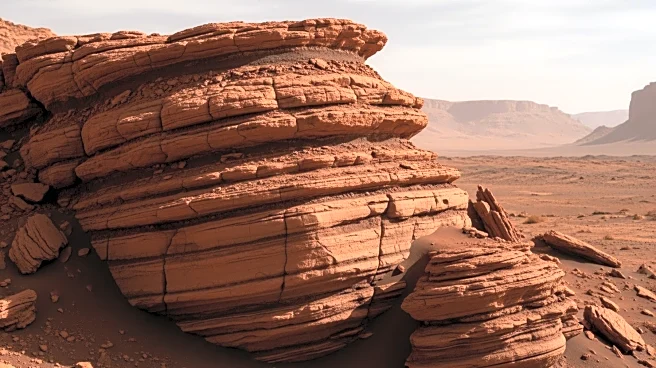
NASA's Curiosity rover has made a groundbreaking discovery on Mars, revealing complex mineral patterns and fracture systems in the Gale Crater. These findings suggest ancient water flows beneath the Martian
surface, providing new insights into the planet's geological past. The rover's analysis of a bedrock target named Tarija, featuring unique lattice-like mineral formations, supports the theory that Mars once had conditions suitable for life. This discovery is part of Curiosity's ongoing mission to explore Mars' ancient habitability and environmental history.
Why It's Important?
The discovery by Curiosity adds a significant piece to the puzzle of Mars' history, particularly regarding its potential to have supported life. Understanding the planet's past water activity is crucial for future exploration missions and the search for past life. These findings could influence the direction of future Mars missions, including the selection of landing sites for rovers and human exploration. The research also contributes to our broader understanding of planetary evolution and the conditions necessary for life, which could have implications for the search for life beyond Earth.
What's Next?
Curiosity will continue its exploration, moving to new locations within the Gale Crater to conduct further analyses. The rover's next phase involves a 54-meter drive to a new site, where it will use autonomous science selection to identify and study promising geological features. This approach allows for more efficient data collection and analysis, potentially leading to more discoveries about Mars' past. The ongoing mission will also focus on understanding the environmental stability of Mars, which is key to assessing its habitability.