







What's Happening?
Mollie Hemingway, editor-in-chief of The Federalist and a Fox News contributor, recently reported an encounter at Washington Dulles International Airport with two Transportation Security Officers (TSOs) who, she stated, lacked sufficient English skills
to answer basic questions. This individual account has drawn attention to the English proficiency requirements for TSOs. The Transportation Security Administration (TSA) explicitly mandates that TSOs must be able to read, write, and speak English adequately to perform screening duties and communicate with English-speaking travelers, as outlined in TSA Management Directive 1100.00-8. Hemingway's experience, while an isolated incident, has prompted a broader discussion about TSA hiring, training, and accountability regarding language skills, particularly for public-facing roles where clear communication is critical for security and operational efficiency.
Why It's Important?
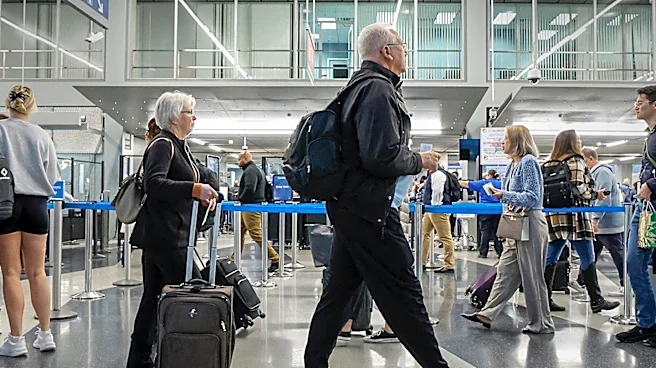
The incident highlights the critical role of clear communication in airport security, which extends beyond customer service to encompass safety and operational effectiveness. TSOs are frontline personnel responsible for screening passengers and property, giving directions, and responding to inquiries in often crowded and stressful environments. A breakdown in communication can slow down checkpoints, frustrate passengers, and potentially hinder the swift execution of security procedures. While multilingual skills are valued by the TSA for assisting non-English speaking travelers, the core requirement for English proficiency ensures that officers can effectively convey instructions and respond to situations that demand immediate understanding. The public's perception of government competence is also influenced by such interactions, making consistent enforcement of language standards vital for maintaining trust in federal security operations.
What's Next?
Following Hemingway's account, the focus shifts to how the TSA addresses and enforces its existing English proficiency standards. If a formal review were to occur, relevant questions would include how English proficiency is assessed during the hiring process, how communication deficiencies are identified post-hiring, and whether TSOs undergo periodic evaluations of their communication skills. The TSA would also need to consider how supervisors respond to passenger complaints regarding communication problems and if ongoing training adequately addresses communication challenges in high-pressure airport environments. The outcome of any potential internal review or public discussion could influence future TSA hiring practices, training protocols, and accountability measures to ensure that all public-facing TSOs consistently meet the required communication standards.
Beyond the Headlines
This incident delves into deeper implications concerning federal employment standards, public trust, and the balance between operational requirements and diversity. While the specific origin of the officers is not the core issue, the discussion touches on the broader debate about immigration and language in federal roles. The case underscores that while multilingualism can be an asset, a foundational level of English proficiency is a non-negotiable operational requirement for TSOs. The controversy also highlights the challenge for federal agencies in maintaining rigorous standards across a large workforce, especially in roles that demand constant public interaction. It prompts reflection on how isolated incidents can trigger widespread scrutiny of established policies and the mechanisms in place to ensure their consistent application, ultimately affecting public confidence in national security infrastructure.