







What's Happening?
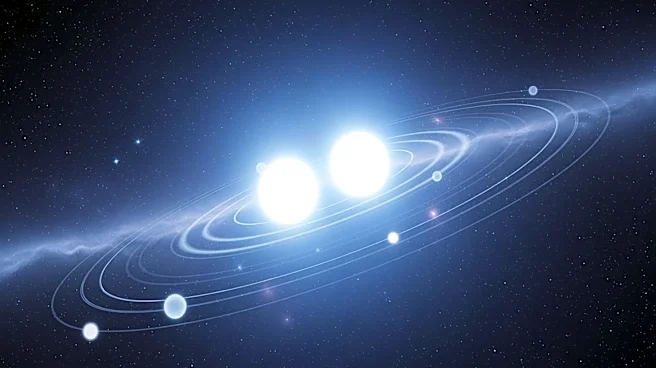
Astronomers have discovered 27 new potential circumbinary planets, which orbit two stars, similar to the fictional planet Tatooine from Star Wars. This discovery, published on Star Wars Day, more than doubles the number of known circumbinary planets.
The research utilized a method called 'apsidal precession' to identify these planets, which are located between 650 and 18,000 light years from Earth. The study, led by Associate Prof Ben Montet from the University of New South Wales, highlights the challenges of detecting such planets due to their alignment with our line of sight from Earth.
Why It's Important?
The discovery of these circumbinary planets expands our understanding of planetary systems and the diversity of planets in the universe. It challenges existing models of planet formation and provides new opportunities to study the dynamics of binary star systems. This research could lead to insights into the conditions necessary for planet formation and the potential for habitable environments in binary systems. The findings also demonstrate the effectiveness of innovative detection methods, which could be applied to discover more exoplanets in the future.
What's Next?
Further research will focus on confirming the existence of these potential planets and determining their characteristics, such as mass and composition. Scientists will continue to refine detection methods to identify more circumbinary planets and study their environments. This could lead to a better understanding of the potential for life in binary star systems and the conditions that support planet formation.